
AMC vs in-house maintenance team Hyderabad MSME factory cost comp
Factory downtime costs lakhs per hour. Learn how AMC vs in-house maintenance team Hy gets resolved fast. MachineryFix connects you with verified technicians via Intelligent Dispatch.

MachineryFix Team
Industrial Repair & Maintenance Experts · 23 September 2026
Need this fixed?
Certified technicians, dispatched from our Hyderabad hub.
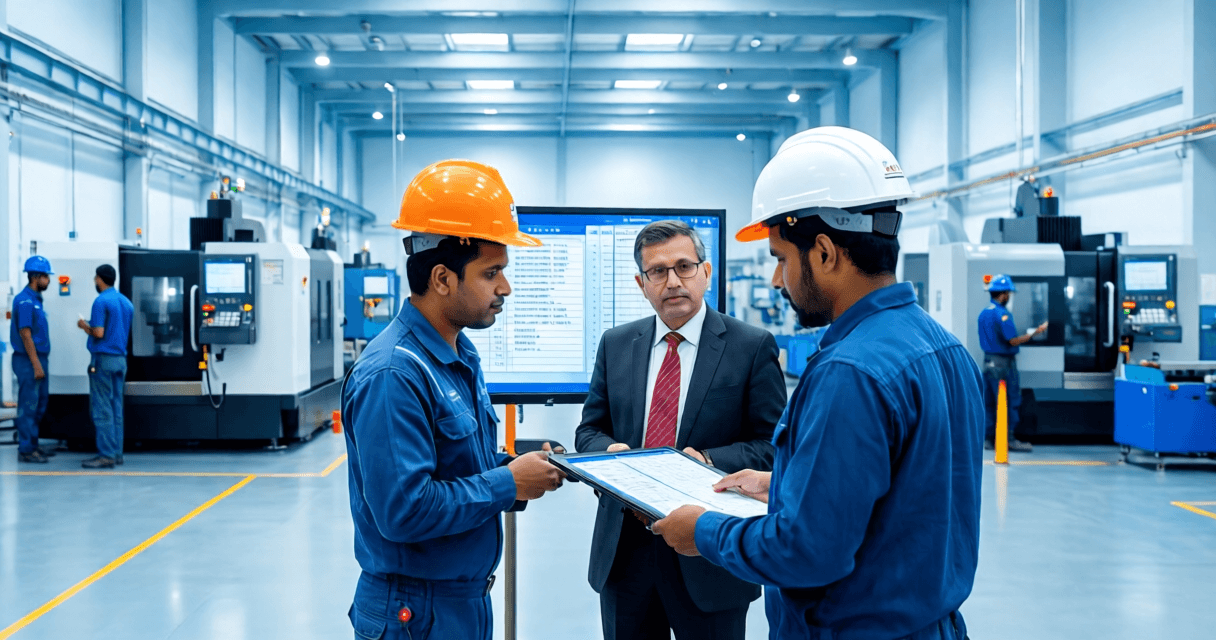
Every hour of unplanned downtime in a Hyderabad MSME factory costs between ₹50,000 and ₹5 lakh — lost production, overtime penalties, missed delivery windows, and the compounding damage to a buyer relationship you spent two years building. For a plant manager running a 40-person shop floor in Kattedan, Balanagar, or Patancheru, the question of AMC vs in-house maintenance team Hy is not a boardroom debate. It is a 2 p.m. Tuesday decision made with a dead hydraulic press, a full shift of idle operators, and a retail-chain buyer calling for a revised delivery date.
The stakes have tightened since 2022. Skilled maintenance engineers in Telangana are scarce, voltage swings across IDA and GIDC zones remain chronic, and the Make in India output push has doubled production expectations on the same 2008-to-2014 machine base. A factory in Jeedimetla or Nacharam can no longer absorb a three-day wait for a VFD board or a qualified hydraulic technician. The MachineryFix platform has compressed that wait to a matter of hours — identity-verified technicians, live dispatch tracking, and a digital job card before the first panel is opened. That shift in response time has rewritten the cost equation for MSME maintenance across Hyderabad's 14 industrial clusters.
Understanding the Failure
A plant manager at a Jeedimetla packaging-unit cluster walked us through the Monday that cost him ₹3.6 lakh. His three-year-old vertical form-fill-seal machine tripped at 6 a.m. The in-house electrician — a single full-time hire at ₹28,000 per month — spent four hours swapping a contactor, only to find the actual fault was a burnt VFD board. The machine sat dead for two full days. Production loss: roughly ₹3.2 lakh in unshipped orders. A ₹40,000 penalty from a retail-chain buyer who did not negotiate.
That is the structural failure mode of the in-house maintenance model for MSMEs in Hyderabad, and it is not a people problem. It is a coverage problem. A single technician, even a competent ITI-certified or diploma-level one, cannot simultaneously service a 12-axis CNC lathe, a 200-ton hydraulic press, a 75 kW rotary screw compressor, and a MIG-TIG welding cell. The skill set spans electrical, mechanical, hydraulic, pneumatic, and PLC/SCADA diagnostics. No one person in a 50-employee factory carries all five competencies at a senior level, and the Telangana labour market does not supply them in the volume a 20-machine shop floor needs.
The cost structure compounds the problem. A full-time maintenance engineer in Hyderabad commands ₹45,000 to ₹75,000 per month. Layer on PF, ESI, statutory leaves, and the 20 to 30 percent of paid hours that go to inventory counting, lubrication rounds, and weekly report writing. Your effective cost per actual repair hour easily crosses ₹2,500. Multiply that by the 14 to 22 breakdowns a mid-size shop floor in Secunderabad or Uppal faces in a year. The in-house model only holds when your machine base is small, homogeneous, and at least a decade old with predictable wear patterns.
The AMC route — whether a traditional vendor contract or an on-demand repair network — inverts the cost model from fixed monthly salary to pay-per-repair with guaranteed response time. You pay when a machine actually fails, and you pay for the specific expertise that failure demands. A hydraulic specialist for the press. A VFD-certified electrician for the CNC. A compressor OEM-trained technician for the rotary screw unit. That is the core of the AMC vs in-house maintenance team Hy comparison, and the arithmetic consistently favours the on-demand model for factories running fewer than 200 machines.
Immediate Response Steps
The first 90 minutes after a critical machine stops determine whether you lose a shift or lose a week. A maintenance head in Nacharam IDA described a compressor failure during the May heat peak: the 90 kW unit tripped, the backup was already running at 85 percent capacity, and the in-house team could not identify which of the three pressure switches had failed. By the time they called an external technician, six hours had passed. The line was down for 14 hours total. The penalty invoice from the downstream buyer arrived the following Wednesday.
A disciplined first-hour protocol for a Hyderabad MSME looks like this:
- Isolate and document. Switch off the faulty unit, note the exact error code on the HMI or PLC panel, photograph the fault indicator, and record ambient temperature and humidity. In Telangana's monsoon, sustained humidity above 85 percent accelerates insulation degradation in motor windings and corrodes terminal blocks. That data is not optional; it is the diagnostic input that separates a 30-minute fix from a two-day teardown.
- Pull the service history. If your factory has been using a platform like MachineryFix, the Digital Service Catalogue for that specific machine serial number is already logged. Previous parts replaced, torque values, diagnostic readings — all retrievable in under two minutes on a phone. That eliminates the "I think we changed that bearing last year" guesswork that costs a technician 40 minutes of reverse-engineering.
- Trigger the dispatch. Call or WhatsApp the emergency line at +91 70133 33007. You describe the symptom, the machine make, and your IDA zone. MachineryFix's 24/7 emergency support channel routes the call to the Intelligent Dispatch Engine, which cross-references the nearest certified expert by skill tag and live availability, then pushes the match to your phone with an ETA and a transparent bid. No call centre. No "let me check with my brother in Secunderabad."
- Verify at the gate. When the technician arrives, their identity is already verified in the system — identity checks, hands-on skill evaluations, and reference audits completed before onboarding. You confirm the name, review the digital job card, and approve the scope of work before any panel is opened.
A plant manager at Balanagar Industrial Zone told us his press line turnaround improved dramatically after adopting this protocol. He was blunt about the reason: "The difference was not the technician's skill. It was killing the four-to-eight-hour window of finding the right person." That window is the in-house model's hidden tax, and it shows up on every invoice you do not get to see.
Common Root Causes
Most breakdowns in Hyderabad's MSME manufacturing base trace back to five recurring root causes, and identifying them changes how you structure your maintenance contract.
Voltage instability and power quality. IDA and GIDC zones across Secunderabad, Patancheru, and Bollaram still experience voltage swings of 12 to 18 percent during peak summer loads, particularly between 11 a.m. and 3 p.m. when every compressor and induction furnace in the cluster draws simultaneously. A CNC spindle drive rated for 415 V 3-phase will see its IGBT modules degrade 3 to 4 times faster under sustained overvoltage. An in-house electrician may replace the IGBT module, but if the root cause is a failing input rectifier or a missing surge suppressor on the panel, the same failure recurs in six weeks. The part is cheap. The downtime is not.
Dust and particulate ingress. Hyderabad's construction boom means airborne silica and cement dust is a constant, especially in open-bay workshops in Kattedan and Jeedimetla. Filter elements on hydraulic systems, PLC cabinet air filters, and compressor intake screens clog at 2 to 3 times the OEM-recommended interval. A single clogged return-line filter on a 200-ton hydraulic press can generate 200 bar pressure spikes that crack a cylinder seal in under 48 hours. The seal kit costs ₹8,000. The press downtime costs ₹2.4 lakh per day.
Monsoon humidity and corrosion. The June-to-September humidity window, sustained above 80 percent, accelerates corrosion on exposed electrical terminals, sensor connectors, and pneumatic fittings. A textile machine in Cherlapally or a welding cell in Kattedan will see intermittent contact faults that are invisible in the dry season and catastrophic in the rains. The fault code reads "random." The diagnosis takes three days. The fix is a ₹2,000 terminal block.
Operator handling and process drift. In a 30-person shop floor, the operator who runs the lathe at 2 a.m. is not the same person who trained on the machine at commissioning. Feed rates drift, coolant concentration drops below 5 percent, and chip evacuation is neglected. These micro-degradations compound over months until a catastrophic bearing failure or spindle seizure occurs. The machine did not break. It was slowly misused, and no one logged the drift.
Aging parts and OEM discontinuation. Many MSME factories in Telangana run machines from 2005 to 2012. OEMs have discontinued several component lines — specific encoder models, hydraulic valve spools, and VFD firmware versions. An in-house team without access to a Vetted Technician Network that carries cross-reference part knowledge will spend days sourcing a single seal kit or a 17-bit encoder. The part exists. The question is whether your one-person maintenance bench knows where.
Preventive Actions
Prevention is where the AMC vs in-house maintenance team Hy comparison gets its sharpest edge, because a single in-house technician's preventive ceiling is low. Lubrication, visual checks, basic megger testing. That is the full scope of what one or two full-time technicians can deliver across 15 to 30 machines, and it is the ceiling, not the floor.
A structured Predictive Maintenance AMC programme, as offered through MachineryFix, layers four additional capabilities on top of that baseline:
- Vibration analysis and thermal imaging on every rotating asset — spindles, gearboxes, compressor rotors, motor bearings — conducted at defined intervals. Typically 90 days for high-speed spindles, 180 days for gearboxes. A bearing with a 0.8 mm outer-race crack shows up on the vibration spectrum 6 to 8 weeks before it fails. The in-house team, without a vibration analyser or the training to read one, will never see it. The bearing will announce itself with a 4 a.m. seizure and a ₹1.8 lakh replacement.
- Oil analysis and coolant concentration checks logged into the Digital Service Catalogues. Trend data across 6 to 12 samples reveals progressive wear metals — iron, copper, aluminium — before a visible leak or temperature spike appears on the shop floor.
- PLC and drive parameter audits. A certified VFD or servo-drive technician reviews current draw, bus voltage, and fault-log history every six months. This catches the slow IGBT degradation or capacitor drift that a contactor swap will not fix. The machine runs. It is dying.
- Seasonal readiness protocols. Before the May heat peak and before the June monsoon, a scheduled inspection covers cooling fans, humidity seals, earth continuity, and backup power transfer switches. In a factory in Bollaram or Patancheru, where the backup generator kicks in 12 to 15 times a month, that transfer switch is the single most critical component in the electrical panel.
The result is measurable. A factory in Kattedan Industrial Area reported that after switching from a single in-house electrician to a Predictive Maintenance AMC with on-demand repair backup, unplanned downtime dropped significantly. The AMC technician's vibration reading in March flagged a spindle bearing issue. The part was replaced in a 4-hour window during a planned weekend shutdown. Without that reading, the spindle would have seized in July, during the hottest production week of the year, with a 10-day replacement lead time from a supplier in Pune.
The cost comparison is stark. The in-house engineer's annual cost: ₹6.5 lakh to ₹9 lakh all-in, including PF, ESI, and the 20 to 30 percent of paid hours spent on non-repair tasks. The Predictive Maintenance AMC for a 20-machine shop floor: ₹3.2 lakh to ₹4.8 lakh, inclusive of four scheduled visits, all diagnostic tools, and priority on-demand repair access. You are paying less, getting broader skill coverage, and eliminating the dead-weight hours that inflate the in-house cost without producing a single repair.
How MachineryFix Helps
The architecture of the repair network matters as much as the individual technician standing at your factory gate. MachineryFix was built for the Indian MSME reality: fragmented machine bases, thin maintenance benches, and a skilled-labour market where finding a verified hydraulic specialist in Sanathnagar on a Sunday morning is nearly impossible through a phone book or a WhatsApp group.
The Intelligent Dispatch Engine handles the matching problem that a phone call cannot. You log the breakdown — machine type, symptom, error code, your IDA zone — and the algorithm matches you with the nearest technician whose skill tag, live availability, and rating align with the fault. The match is instant, the ETA is transparent, and you can compare bids from two or three qualified experts before accepting. That competitive bidding mechanism saved a plant manager in Jeedimetla 20 percent on a single hydraulic repair, and the number is not an outlier. It is the structural effect of removing the "one technician, one price" monopoly that the in-house model creates.
The Vetted Technician Network is not a directory. Every technician passes identity verification, a hands-on skill evaluation on a live machine, and a reference audit before they appear in the dispatch pool. They carry OEM-grade parts, not generic substitutes from a local electrical market. They log every action into the Digital Service Catalogues, creating a repair history that a compliance auditor at an ISO 9001 or ISO 14001 review can pull in seconds. A quality head in Cherlapally called those digital service logs "fantastic for ISO audits" because the timestamp, technician ID, parts serial numbers, and diagnostic readings sit in one searchable record. No more flipping through a notebook in a drawer in the store room.
Factory owners can book a certified technician directly from their phone, with upfront pricing before any work begins. All communication stays inside the app, which keeps your production data, machine serial numbers, and process parameters out of the hands of unverified third parties. Technicians receive weekly payouts with full financial transparency, which keeps the talent pool stable and motivated. The mutual rating system does the rest: a technician who diagnoses accurately and completes on time earns more dispatches. One
Published on
India's on-demand industrial repair platform — certified technicians dispatched fast.
Frequently Asked Questions
How do I get a technician for AMC vs in-house maintenance team Hy in Hyderabad?
MachineryFix's Intelligent Dispatch Engine matches your breakdown with the nearest verified technician in Hyderabad. Available 24/7 for emergency support. Book at machineryfix.com or WhatsApp +91 70133 33007.
Are MachineryFix technicians verified and experienced?
Yes. Every technician on MachineryFix is an experienced engineer or technician, passing rigorous skill evaluation before being onboarded. This is why MachineryFix maintains a 4.8/5 average rating from factory clients across India.
What is a Predictive Maintenance AMC and how does it work?
A Predictive Maintenance AMC (Annual Maintenance Contract) from MachineryFix covers scheduled inspections, condition monitoring, and priority emergency response. It reduces unplanned breakdowns by 40-60% and is ideal for factories running critical CNC, hydraulic, or textile machines.
How much does industrial machine repair cost in India?
Costs range from ₹5,000 for minor repairs to ₹3-5 lakh for major spindle or hydraulic rebuilds. MachineryFix uses competitive bidding — you receive upfront proposals from multiple local experts before committing, so you always get a fair price.
What documentation does MachineryFix provide after a repair?
MachineryFix generates a Digital Service Catalogue entry for every job — logging the fault, diagnosis, parts replaced, technician ID, and timestamps. This digital job card is accepted for ISO 9001 and GMP compliance audits.
Can I rehire the same technician for future jobs or an AMC?
Yes. MachineryFix's re-hiring feature lets you save a preferred technician directly to your account. You can rebook them for follow-up work, recurring maintenance, or a full AMC contract — keeping your factory history consistent.
Need a certified technician?
Get one dispatched fast.