
AMC vs in-house maintenance team Hyderabad MSME factory cost comp
Factory downtime costs lakhs per hour. Learn how AMC vs in-house maintenance team Hy gets resolved fast. MachineryFix connects you with verified technicians via Intelligent Dispatch.

MachineryFix Team
Industrial Repair & Maintenance Experts · 27 September 2026
Need this fixed?
Certified technicians, dispatched from our Hyderabad hub.
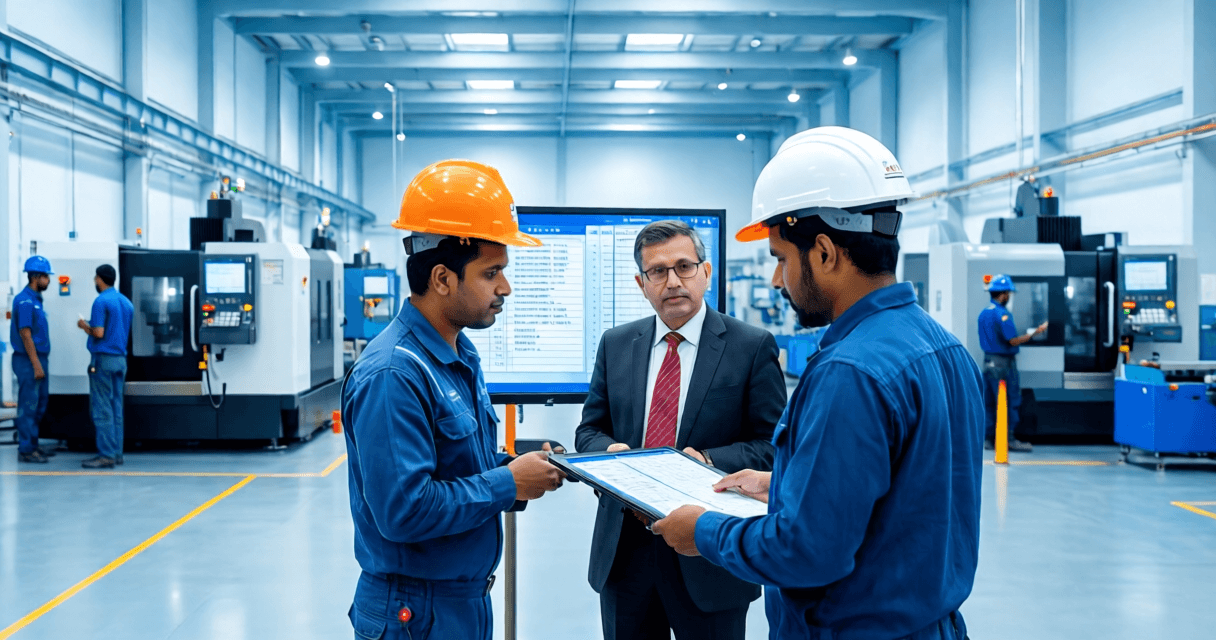
Every hour of unplanned downtime at an Indian MSME factory drains between ₹50,000 and ₹5,00,000 in lost production, missed delivery slots, and penalty clauses. In a 60-station packaging line in Balanagar Industrial Zone, that single hour erases an entire week's margin. In a 20-machine CNC unit in Kattedan, it wipes out the quarter's net profit. The AMC vs in-house maintenance team Hy question is no longer a back-office discussion. It is the single most consequential capital allocation decision a Telangana plant manager makes in a year, and the wrong answer bleeds cash every quarter, every monsoon, every load-shedding week.
A compressor failure at 2:00 AM on a Tuesday in Nacharam IDA cascades into three days of zero output if the right hydraulic specialist is not at the factory gate by 6:00 AM. The maintenance model you have in place determines whether that cascade happens or whether the machine is back spinning within four hours. There is no middle ground. The machine either runs or it does not, and the gap between those two states is measured in the architecture of your repair response.
Understanding the Failure
A typical Hyderabad MSME factory runs between 8 and 120 machines, and each one carries its own failure signature. CNC lathes, hydraulic presses, air compressors, conveyor belts, welding rigs, packaging units, and textile looms do not break in the same way, at the same rate, or for the same reason. The structural problem is not that machines fail. It is that no single in-house technician can credibly diagnose a FANUC CNC spindle error, troubleshoot a 315-ton hydraulic press actuator leak, and recalibrate a servo-driven packaging sealer in the same shift. In Uppal Industrial Area, where voltage swings of 180V to 250V are routine during peak summer load-shedding, electrical and mechanical failures overlap in ways that demand cross-disciplinary expertise no single full-time employee holds.
The economics make the gap concrete. A mid-level maintenance engineer in Hyderabad commands a CTC of ₹6.5 to ₹9 lakh per annum, plus ESIC, PF, leave encashment, and the cost of a dedicated workshop bay with calibrated tools. For a 15-machine unit in Sanathnagar, that is a fixed overhead of roughly ₹11 to ₹14 lakh per year for one person who will still be unavailable on weekends, public holidays, and the 2:00 AM emergency that actually costs the most. Multiply that by the two or three disciplines a working factory genuinely needs, and the in-house team budget crosses ₹30 lakh annually before a single bolt is turned.
The second hidden cost is utilisation. An in-house technician spends 60 to 70 percent of his time on low-value tasks: greasing bearings, replacing belts, checking oil levels, writing daily log entries. The 20 to 30 percent of his skill that actually matters, diagnosing an intermittent servo fault or interpreting a pressure-drop pattern on a hydraulic circuit, goes underused because he is tied to the shop floor. The high-complexity failure that hits on a Sunday night has no one to call. The factory sits idle. The order slips. The penalty clause triggers.
The MachineryFix platform addresses this gap directly. Its Intelligent Dispatch Engine matches a specific breakdown profile to the nearest certified expert by skill, proximity, and current availability, so a factory in Kattedan does not pay a monthly salary for a person it needs for four hours a month. It pays for the hour, the part, and the expertise, and the technician is already on the road. The model treats repair capability as a service you access, not a headcount you carry.
Immediate Response Steps
The first 30 minutes after a machine stops determine whether the repair takes two hours or two days. In a two-shift factory in Jeedimetla, a hydraulic press failure at 3:15 PM means the evening shift has no work, the next morning's dispatch is in jeopardy, and the client's quality team is already asking questions on the phone.
The response protocol should be drilled into every shift supervisor:
- Isolate and secure. Lock out the machine, tag it, and photograph the failure state. Do not attempt a "quick fix" by a production operator. A misaligned coupling re-engaged under load can destroy a ₹18 lakh gearbox.
- Capture the error code and symptoms. Note the exact alarm number on the CNC screen, the hydraulic pressure reading at the gauge, the frequency of the compressor cycling, or the specific weld spatter pattern. Write it down. Photograph it. This is the single most valuable input for any repair technician, whether in-house or external.
- Log the time and impact. Record the exact stoppage time, the number of operators now idle, and the estimated revenue loss per hour. This data becomes your negotiation leverage and your internal justification for the maintenance model you eventually choose.
- Call the right person. If your in-house team cannot resolve it within 45 minutes, escalate immediately. Do not wait for the morning shift. A 4.8/5 average-rated service network with 24/7 emergency support is not a luxury; it is the difference between a 4-hour repair and a 3-day shutdown.
A plant manager in Kattedan Industrial Area told the MachineryFix team that after switching from an in-house two-person maintenance setup to on-demand verified technicians, his unplanned downtime dropped significantly. The key was not the quality of the technicians. It was the speed of dispatch. His old process ran: call a local mechanic, wait for a callback, wait for the visit, wait for parts. The new process runs: describe the problem in the app, compare two or three bids with ETAs, accept the best, and track the technician's live location from the factory gate. Total time from breakdown to technician-at-machine: under 90 minutes.
For Indian factory owners who need to act fast, the Book a Technician page on machineryfix.com puts a verified technician on the road with upfront pricing and an identity check before the technician reaches your gate. No phone-tag. No "I will call you back." No 14-hour wait.
> MSME factory owners across India use machineryfix.in to book experienced engineers and technicians with upfront pricing and digital job cards — all from a phone.
Common Root Causes
Machines in Hyderabad factories do not fail randomly. They fail because of a small set of recurring environmental and operational stressors specific to Indian manufacturing conditions, and understanding those root causes is what separates a reactive maintenance budget from a strategic one.
Voltage instability and power quality. The Telangana grid, particularly in industrial clusters like Bollaram, Patancheru, and Secunderabad, experiences voltage sags of 15 to 20 percent during peak loading hours (11 AM to 3 PM in summer). CNC servo drives, VFD-controlled compressors, and inverter-fed hydraulic pumps are all sensitive to this. A single unlogged voltage sag can degrade a servo amplifier over 40 to 60 cycles, after which the machine starts throwing intermittent axis errors that no in-house technician can reproduce during a daytime inspection. The failure is invisible until it is not.
Monsoon humidity and dust ingress. The Hyderabad monsoon, peaking between June and September, pushes ambient humidity above 85 percent in open or semi-open workshop bays. Electrical contactors corrode. PCB connectors develop micro-oxidation. In a textile unit in Cherlapally, a single season of monsoon can degrade the insulation resistance of a 50 HP spindle motor enough to cause intermittent ground faults that only appear under load. Dust from the production process, combined with humidity, creates a conductive slurry that accelerates wear on linear guides and ball screws.
Parts obsolescence and grey-market components. A large share of MSME repairs in India still uses non-OEM or reconditioned parts sourced from local markets. A ₹8,000 aftermarket hydraulic seal that should last 18 months fails in 6 weeks, and the resulting fluid contamination takes out the proportional valve that cost ₹1.2 lakh. The root cause is not the seal. It is the absence of a documented parts history and a verified supply chain.
Operator training gaps. In a 40-person factory in Nacharam IDA, the same operator may run three different machine types across two shifts. Cross-training is rare. A minor parameter adjustment made "to get it running faster" can push a spindle into thermal overload within a week, and the resulting bearing damage does not show up on a visual inspection for another 200 hours.
These causes are not exotic. They are the daily reality of Indian manufacturing. And they are precisely the failure modes that a single in-house technician, stretched across 15 machines and three disciplines, cannot track systematically.
Preventive Actions
Prevention is where the AMC model and the in-house model diverge most sharply in cost. An in-house team can perform scheduled greasing, belt tensioning, and visual inspections. What it cannot do, without a structured program and dedicated tooling, is run the deeper diagnostics that catch failure 60 to 90 days before it becomes a breakdown.
A structured Predictive Maintenance AMC changes the equation. Instead of reacting to a spindle alarm, the technician arrives monthly with vibration analysis equipment, checks the motor current signature, inspects the hydraulic fluid for particulate contamination, and logs every reading in a Digital Service Catalogue. Over six months, that catalogue builds a trend line. The spindle bearing that was 82 percent healthy in January is at 64 percent in April. The hydraulic fluid particle count that was within ISO 4406 limits in February is drifting in May. The technician flags it. The part is ordered. The replacement happens during a planned shutdown on a Sunday, not during a Tuesday production run.
The preventive checklist for a Hyderabad MSME factory should include:
- Monthly vibration and thermal scan on all rotating equipment (spindles, compressor pistons, pump motors)
- Quarterly hydraulic fluid analysis with particle count and water content test
- Bi-annual electrical insulation resistance test on all motors and drives, timed before the monsoon
- Annual recalibration of servo axes and hydraulic pressure transducers
- Continuous dust management: compressed-air blow-down schedules, HEPA filtration on CNC enclosures, and sealed electrical cabinets in humid zones
None of this requires a full-time team. It requires a scheduled, skilled set of hands that arrive with the right instruments, perform the checks, log the data, and flag the trend. That is a service, not a salary. And the data, stored in a digital catalogue with a full repair history, parts replaced, and diagnostic notes, doubles as your evidence file for ISO 9001 audits. A maintenance head in Cherlapally noted that the digital service logs from her factory's external maintenance provider made the annual ISO audit "fantastic" because every intervention was timestamped, photographed, and tied to a specific machine serial number. No more reconstructing paper records from memory at 11 PM the night before the auditor arrives.
How MachineryFix Helps
The MachineryFix platform operates four core modules, each addressing a specific structural failure in the traditional in-house maintenance model.
The Intelligent Dispatch Engine takes your breakdown description, the machine make and model, the error code, and your factory location, then matches it to the nearest certified technician who has demonstrated competence on that specific machine class. A hydraulic press failure in Balanagar routes to a hydraulic specialist in Secunderabad, not to a general electrician in Patancheru. The matching is algorithmic, proximity-weighted, and skill-verified. You receive two to three bids with upfront pricing and confirmed ETAs, and you choose. This is competitive bidding in practice, not in theory. A production head in Jeedimetla Cluster reported saving 20 percent on a repair by comparing two bids before accepting.
The Vetted Technician Network is not a directory. Every technician undergoes identity verification, skill evaluation on real machines, and a performance review before being activated on the platform. The 4.8/5 average rating across all completed jobs is the aggregate of two-way feedback where the factory rates the technician and the technician rates the factory's access and clarity. A technician who cannot access the machine, or whose diagnostic is rushed, does not maintain that rating.
The Digital Service Catalogue means that every repair, every part replaced, every diagnostic reading, and every photo is stored against the machine's serial number. When the same hydraulic cylinder fails 14 months later, the technician sees that it was replaced 14 months ago, by whom, with which OEM part number, and under what operating conditions. That history changes the diagnosis. It also changes the audit trail.
The Predictive Maintenance AMC module is the structured annual contract for factories that want scheduled visits, trend tracking, and priority dispatch. It is not a retainer for a person. It is a retainer for a capability. You pay for the visits, the diagnostics, and the priority queue. The technicians remain independent, verified, and dispatched by the engine.
For emergencies, the platform offers 24/7 emergency support. A breakdown at 1:00 AM in a two-shift factory in Uppal is handled the same way as a 10:00 AM breakdown. The dispatch engine does not sleep. The technician network is on-call. A WhatsApp message to +91 70133 33007 initiates the same structured process: describe, match, dispatch, track, repair, log.
Why MachineryFix Is India's Fastest Repair Network
Speed in industrial repair is not about one technician driving faster. It is about eliminating every layer of delay between the moment a machine stops and the moment a qualified expert is standing in front of it with the right tool and the right part. In the traditional in-house model, that chain runs: operator notices fault, calls the in-house technician, technician assesses, calls a specialist, specialist calls a parts supplier, parts supplier confirms delivery, repair begins. Five handoffs. Eight to 36 hours.
In the MachineryFix model, the chain runs: operator or plant manager describes the fault in the app, the Intelligent Dispatch Engine matches the nearest verified specialist, the technician accepts the bid and is dispatched, the factory manager tracks the live location, the technician arrives, diagnoses, repairs with OEM-grade parts, logs the job digitally, and the factory manager approves and pays. Three handoffs. Under 90 minutes in most Hyderabad clusters.
The network covers 14 machine categories, from CNC lathes and hydraulic presses to compressors, welding equipment, conveyor systems, and textile machines. The service footprint is pan-India, but the density in Hyderabad and Telangana industrial clusters, Uppal, Kattedan, Balanagar, Jeedimetla, Cherlapally, Secunderabad, Patancheru, Nacharam IDA, Bollaram, and Sanathnagar, means the nearest verified technician is rarely more than 20 to 30 minutes away.
The mutual rating system holds the quality floor. The digital service logs keep the compliance file clean. The competitive bidding keeps pricing honest. The privacy architecture keeps all communication, pricing, and service data inside the platform, so your factory's operational details never leak into a local market.
The decision was never whether to repair the machine. It was whether to carry the fixed cost of a team that will be 60 percent idle, or to access a verified, dispatched, logged, and rated network of specialists on demand, at competitive prices, with 24/7 availability. For a Hyderabad MSME factory running 10 to 100 machines, the arithmetic is no longer close.
When your next machine goes down, do not wait for the morning shift. Do not call a number you found on a local market board. Open the Book a Technician page on machineryfix.com, describe the fault, compare the bids, and track the verified technician to your gate. Or WhatsApp +91 70133 33007 right now and get a confirmed ETA before your next production lot is at risk. Downtime is the only cost in manufacturing you can eliminate entirely. The dispatch engine is running. Your machine does not have to wait.
Published on
India's on-demand industrial repair platform — certified technicians dispatched fast.
Frequently Asked Questions
How do I get a technician for AMC vs in-house maintenance team Hy in Hyderabad?
MachineryFix's Intelligent Dispatch Engine matches your breakdown with the nearest verified technician in Hyderabad. Available 24/7 for emergency support. Book at machineryfix.com or WhatsApp +91 70133 33007.
Are MachineryFix technicians verified and experienced?
Yes. Every technician on MachineryFix is an experienced engineer or technician, passing rigorous skill evaluation before being onboarded. This is why MachineryFix maintains a 4.8/5 average rating from factory clients across India.
What is a Predictive Maintenance AMC and how does it work?
A Predictive Maintenance AMC (Annual Maintenance Contract) from MachineryFix covers scheduled inspections, condition monitoring, and priority emergency response. It reduces unplanned breakdowns by 40-60% and is ideal for factories running critical CNC, hydraulic, or textile machines.
How much does industrial machine repair cost in India?
Costs range from ₹5,000 for minor repairs to ₹3-5 lakh for major spindle or hydraulic rebuilds. MachineryFix uses competitive bidding — you receive upfront proposals from multiple local experts before committing, so you always get a fair price.
What documentation does MachineryFix provide after a repair?
MachineryFix generates a Digital Service Catalogue entry for every job — logging the fault, diagnosis, parts replaced, technician ID, and timestamps. This digital job card is accepted for ISO 9001 and GMP compliance audits.
Can I rehire the same technician for future jobs or an AMC?
Yes. MachineryFix's re-hiring feature lets you save a preferred technician directly to your account. You can rebook them for follow-up work, recurring maintenance, or a full AMC contract — keeping your factory history consistent.
Need a certified technician?
Get one dispatched fast.