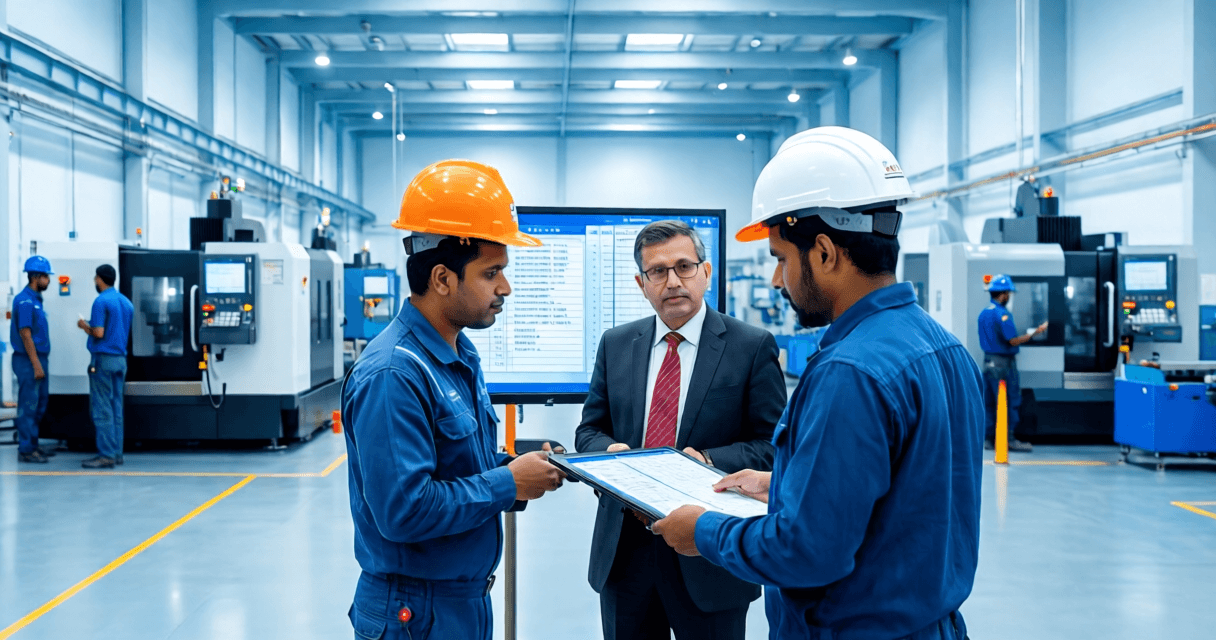

AMC vs in-house maintenance team Hyderabad MSME factory cost comp
Factory downtime costs lakhs per hour. Learn how AMC vs in-house maintenance team Hy gets resolved fast. MachineryFix connects you with verified technicians via Intelligent Dispatch.

MachineryFix Team
Industrial Repair & Maintenance Experts · 5 October 2026
Need this fixed?
Certified technicians, dispatched from our Hyderabad hub.
A single hour of unplanned downtime on a hydraulic press or CNC machining centre in Hyderabad's MSME belt costs between ₹50,000 and ₹5 lakh — lost production, overtime backlogs, and the penalty clauses that Tier-1 auto-component clients write into every purchase order. In a three-shift operation running out of Uppal or Balanagar, that number is not a line item in a risk register. It is the reason a plant manager is still awake at 2 a.m., listening to the accumulator hiss and the ram stall mid-cycle, knowing that the one technician on the night roster is already 40 minutes late and the client's delivery window closes at 6.
The arithmetic behind the AMC vs in-house maintenance team Hyderabad decision is brutal. A Fanuc servo drive failure on a CNC machining centre in a Jeedimetla packaging unit that drags on for six hours means a missed shipment, a written penalty from the OEM client, and fourteen operators standing idle while the supervisor burns through his phone book looking for someone who can actually read a drive fault code. Multiply that by the fixed payroll of a full-time CNC machinist in Hyderabad — ₹35,000 to ₹55,000 per month, plus ESIC, PF, and the accumulated leave encashment that builds silently on the balance sheet — and the in-house model carries a cost whether the spindle turns or not. The machine does not. The salary does.
Understanding the Failure
"Machine is down" is a symptom, not a diagnosis, and treating it as one is the single most expensive habit in a Hyderabad MSME maintenance shop. A hydraulic press in a Cherlapally stamping unit that stops mid-cycle could be suffering from a blown pressure relief valve, a contaminated fluid line, a failed proximity sensor on the ram, or a three-phase voltage sag caused by the 33 kV feeder carrying an extra 20% load during a May heat wave when every AC compressor in the GIDC cluster kicks in simultaneously. Each of those four failures demands a different repair path, a different parts inventory, and a different skill set. A general electrician fixes the first. A hydraulic specialist handles the second. A sensor technician diagnoses the third. The fourth requires a power-quality engineer with a clamp meter and a scope.
The in-house maintenance model was designed for a factory that ran one or two machines, where the maintenance head could walk the shop floor every thirty minutes, tighten a bolt, top up hydraulic oil, and call it a day. That architecture is breaking under the pressure of modern MSME operations. A typical 20,000 sq ft unit in the Nacharam IDA zone now runs four to eight CNC machines, two hydraulic presses, a compressor bank, a conveyor loop, and a welding bay. The maintenance workload has quadrupled. The headcount in most Hyderabad MSMEs has not moved.
The pattern that follows is predictable and chronic. The one maintenance technician on the roster is stretched across every asset, performing reactive fixes at 11 p.m. after the third shift ends. He is not running preventive inspections. He is not updating lubrication schedules. He is not logging fault codes into any system that a client auditor could pull up. When the critical spindle bearing finally fails during a peak production week, the factory has no backup technician, no spares kit calibrated to that specific make and model, and no external support channel that can respond before the client's quality audit window closes.
Rakesh Sharma, a plant manager in the Kattedan Industrial Area, put it plainly: his unplanned downtime dropped significantly after he stopped relying on a single in-house technician and started routing breakdowns through the MachineryFix platform to reach a pool of verified specialists on demand. The structural shift — from one person expected to fix everything to the right specialist matched to the right failure — is the change that separates a factory that recovers in a day from one that loses a week.
Immediate Response Steps
The first twenty minutes after a machine goes down on the shop floor in Bollaram or Sanathnagar determine whether the incident costs two hours or twenty. The sequence below is what experienced maintenance engineers in Telangana have converged on after years of 2 a.m. breakdowns, and it holds whether the fix comes from an in-house bench or an external network.
- Isolate and secure before anything else. Lock out the machine, tag the breaker, and confirm the area is safe. In a hydraulic press bay, that means verifying the ram is fully retracted and the accumulator pressure is bled to zero before any technician approaches the cylinder. A 200-tonne press in a Jeedimetla stamping shop does not forgive a premature reach.
- Capture the fault state while it is still there. Photograph the error code on the HMI panel, note the spindle speed at the moment of failure, record the last tool number or die position, and write down the ambient conditions. A voltage fluctuation during a monsoon afternoon in Uppal, when humidity sits above 85% and the 33 kV feeder is shedding load, produces a different servo fault signature than a bearing failure after 12,000 hours of continuous operation. The two look similar on the panel. They are not the same problem.
- Document the sequence of events before the memory fades. What was the machine doing in the last five minutes? Did the operator change a G-code program? Was there a power dip that tripped the compressor simultaneously? Did the cooling fan stop thirty seconds before the spindle alarm? This context is the difference between a 40-minute repair and a three-day parts wait from a distributor in Andheri.
- Escalate with specifics, not adjectives. Do not call a technician and say "the machine is not working." State the make, model, serial number, the exact error code, the symptom, and your location in the industrial cluster. The Intelligent Dispatch Engine on the MachineryFix platform is built to consume exactly that data structure, matching the breakdown profile with the nearest certified expert who has handled that specific fault class before, rather than routing the job to whoever is closest on a map.
- Set a hard decision deadline. If the in-house technician cannot identify the root cause within 45 minutes, the plant manager makes the call to engage external support. Every additional hour of diagnosis while production sits at zero is ₹50,000 to ₹5 lakh walking out of the building. The deadline is not a suggestion. It is the cost of inaction made visible.
The discipline in this sequence is what separates a factory that recovers in three hours from one that loses an entire production week. A structured on-demand repair service enforces that discipline by design. The dispatch algorithm does not sit in a queue waiting for the plant manager to "think it through." It matches, dispatches, and tracks, and the technician is already on the road.
Common Root Causes
Service logs pulled from across Hyderabad's manufacturing clusters — Uppal, Kattedan, Balanagar, Jeedimetla, Cherlapally, Secunderabad, Patancheru, Nacharam IDA, Bollaram, Sanathnagar — show a consistent pattern in the top failure modes that hit MSME machines. Recognising those patterns is what allows a maintenance engineer to shift from perpetual firefighting to structured prevention, and it is the foundation on which any AMC or in-house programme must be built.
Electrical and drive failures account for the largest share of breakdowns. India's power infrastructure, even in well-connected zones like the Gachibowli or Whitefields industrial parks, still experiences voltage sags of 10 to 15% during peak summer load when the TNPD grid is pushing 33 kV feeders past their rated capacity. A VFD in a compressor or a servo amplifier in a CNC axis is designed for a ±10% tolerance. Push it to ±15% for six months of Hyderabad's 42°C afternoons, and the IGBT modules degrade at the semiconductor level. The machine still runs, but the drive throws intermittent over-current faults that no amount of "resetting the panel" will permanently fix. The fix requires a drive specialist with a thermal camera and a spare IGBT module, not a general electrician with a multimeter.
Hydraulic and pneumatic contamination is the second major category, and it is uniquely aggravated in Telangana. The industrial air in the Hyderabad belt carries a fine silicate dust, especially during the dry season from October to March, when the Deccan plateau dust settles over the factory floor. In a unit in Jeedimetla or Kattedan, that dust enters through every unsealed fitting, every worn gland, and every open oil reservoir. Over eighteen months, the contamination degrades valve spools, clogs pilot lines, and causes pressure drift that an operator mistakes for "the machine is getting old." The machine is not old. It is dirty.
Mechanical wear on precision components — spindle bearings, ball screws, way covers, die sets — follows a predictable fatigue curve, but only if the machine is run within its rated duty cycle. Many MSME operators in the Balanagar and Secunderabad belt push machines past their rated feed rate to meet delivery deadlines, accelerating wear by 30 to 40% and turning a 24-month bearing life into a 14-month failure. The bearing does not know it is being overworked. It simply fails, usually during the week the client's quality engineer is on site.
Operator handling and programming errors round out the list. A new operator who has not completed a structured CNC service training module will crash a tool into a workpiece, damage a chuck jaw, or overload a hydraulic circuit by entering the wrong pressure parameter. These are not machine failures. They are process failures, and no amount of in-house maintenance headcount fixes them. The fix is a training protocol, a parameter lock, and a supervisor who checks the program before the operator hits cycle start.
Preventive Actions
A factory that experiences three major breakdowns a year and one that experiences them monthly are running the same machines on the same floor. The difference is the structure of the maintenance programme behind them. A plant manager in Hyderabad weighing the AMC vs in-house maintenance team Hyderabad trade-off should evaluate both options against the five actions below and ask a single question: can my current setup actually execute all five, consistently, with documentation, without being derailed by an emergency repair at 9 p.m.?
- Scheduled lubrication and fluid analysis. Every hydraulic circuit, every gear reducer, every spindle bearing needs a documented lubrication interval. In an in-house setup, this depends on one technician remembering to do it between fixing a hydraulic leak and writing an ISO checklist. In a structured AMC framework, it is a line item with a date, a technician assignment, and a digital log entry that the plant manager can verify from his phone.
- Thermal imaging of electrical panels. A single thermal scan of a 400 A MCC panel can identify a loose connection that will arc and burn a contactor within six weeks. Most MSME factories in Telangana have never had a thermal scan performed on their distribution boards. The in-house team rarely carries the equipment. A vetted external team brings a FLIR or equivalent on every scheduled visit and logs the reading into the service record.
- Spindle and axis calibration checks. A CNC machine that has drifted 0.015 mm on the X-axis will pass a visual inspection and fail a client's dimensional audit the same afternoon. Regular laser interferometer checks, or at minimum a test-cut verification with a calibrated ring gauge, are non-negotiable for any shop supplying auto or aerospace components in the Hyderabad belt.
- Environmental control. Monsoon humidity in Hyderabad can exceed 90% relative humidity for weeks, and the condensation that forms on PCBs, corrodes electrical connectors, and degrades hydraulic seal materials is the quiet killer of drive electronics in a Patancheru or Secunderabad unit. A dehumidifier in the machine enclosure, sealed way covers, and a desiccant charge in the electrical cabinet are low-cost actions that prevent a disproportionate share of electrical faults that otherwise show up as "intermittent faults" in the service log.
- Digital maintenance logging. Every inspection, every parts replacement, every fault code should be recorded in a system that the plant manager can pull up during an ISO 9001 audit or a client quality review. Anita Desai, a plant manager in Cherlapally, noted that the digital service logs generated through her external maintenance partner made her ISO audit preparation significantly faster than the paper notebooks her previous in-house team maintained. The auditor did not have to ask "where is the record for the bearing replacement on the No. 3 lathe?" The record was on a screen, timestamped, with the technician's name and the part number.
A single in-house technician, managing eight machines across three shifts, cannot execute all five of these actions on schedule, with documentation, without being pulled into an emergency repair at 9 p.m. The mathematics of the workload does not change with goodwill.
How MachineryFix Helps
The MachineryFix model is built for a specific Hyderabad MSME reality: a factory that cannot afford a five-person maintenance department but cannot afford to lose a production day either. The platform operates as a fact on the ground, not a concept in a pitch deck.
The Intelligent Dispatch Engine takes the breakdown profile — machine make, model, fault code, symptom description, and factory location — and matches it with the nearest certified expert in the Vetted Technician Network who has demonstrated competency in that specific failure class. A servo drive fault on a Mazak CNC in Patancheru is not routed to a general electrician. It is routed to a drive specialist who has logged 40 or more similar repairs, verified through the platform's identity checks and skill evaluations before onboarding. The match is based on fault-class competency and proximity, not on who answered the phone first.
The competitive bidding mechanism means the plant manager sees two or three qualified technicians, their proposed approach, their ETA, and their pricing, and selects the best fit. Priya Kumari, a factory owner in the Jeedimetla cluster, reported that competitive bidding saved her team roughly 20% on a hydraulic press repair compared to the flat-rate quote from her previous single-vendor arrangement. The plant manager is not locked into a single service provider, bound by an annual minimum call-out, or obligated to accept the first name that shows up at the gate.
For factories that want to move from reactive to proactive, the Predictive Maintenance AMC module structures quarterly or semi-annual visits with a defined scope: thermal scans, fluid analysis, calibration checks, lubrication, and a full condition report entered into the Digital Service Catalogue. The plant manager gets a running history of every machine, every part replaced, every diagnostic reading, all accessible from a phone. The record an ISO auditor or a client quality engineer wants to see is generated automatically after each visit, not reconstructed from memory at 11 p.m. the night before the audit.
The 24/7 emergency support channel means that when the compressor trips at 1 a.m. during a weekend production run in Uppal, the plant manager does not spend an hour scrolling through a WhatsApp group asking "who can fix a Kaeser compressor." The support line is open, the dispatch engine is running, and a verified technician is already in motion. Indian factory owners can book a certified technician directly from their phone, with upfront pricing and a live tracking status from dispatch to factory gate. No call centre. No voicemail. No "we will get back to you by Monday."
The 4.8/5 average rating across the platform is the aggregate of two-way feedback from factory managers and technicians on every completed job, logged in the same digital service record the plant uses for compliance. The mutual rating system keeps both sides accountable in a way that a single in-house employee, who cannot be replaced without a 30-day notice period and a severance calculation, simply cannot.
Why MachineryFix Is India's Fastest Repair Network
A 20,000 sq ft unit in the Nacharam or Sanathnagar belt in 2025 runs eight precision machines, a client audit is three weeks away, and the one technician on the roster is simultaneously fixing a hydraulic leak, writing an ISO checklist, and trying to remember which bearing was last replaced on the No. 3 lathe. The in-house maintenance team was the right answer when a factory ran two machines and the maintenance head knew every bolt by name. The machine count has quadrupled. The headcount has not. The model has not kept up.
The factory that can call a verified CNC drive specialist in 45 minutes, compare two bids before accepting, track the technician's approach on a live map, and receive a digital job card with OEM-grade parts documentation in the same afternoon is operating in a different league than the factory waiting for Monday's service visit. The difference is not the quality of the machine on the floor. It is the speed and specificity of the repair response when the machine stops.
MachineryFix's network spans Hyderabad's industrial clusters — Uppal, Kattedan, Balanagar, Jeedimetla, Cherlapally, Secunderabad, Patancheru, Nacharam IDA, Bollaram, and Sanathnagar — with technicians who are identity-verified, skill-evaluated, and rated by the factory managers they serve. The Intelligent Dispatch Engine matches the fault profile to the specialist who has fixed that exact failure before, at the closest feasible distance, at a price the plant manager has seen and approved before the work begins. S
Published on
India's on-demand industrial repair platform — certified technicians dispatched fast.
Frequently Asked Questions
How do I get a technician for AMC vs in-house maintenance team Hy in Hyderabad?
MachineryFix's Intelligent Dispatch Engine matches your breakdown with the nearest verified technician in Hyderabad. Available 24/7 for emergency support. Book at machineryfix.com or WhatsApp +91 70133 33007.
Are MachineryFix technicians verified and experienced?
Yes. Every technician on MachineryFix is an experienced engineer or technician, passing rigorous skill evaluation before being onboarded. This is why MachineryFix maintains a 4.8/5 average rating from factory clients across India.
What is a Predictive Maintenance AMC and how does it work?
A Predictive Maintenance AMC (Annual Maintenance Contract) from MachineryFix covers scheduled inspections, condition monitoring, and priority emergency response. It reduces unplanned breakdowns by 40-60% and is ideal for factories running critical CNC, hydraulic, or textile machines.
How much does industrial machine repair cost in India?
Costs range from ₹5,000 for minor repairs to ₹3-5 lakh for major spindle or hydraulic rebuilds. MachineryFix uses competitive bidding — you receive upfront proposals from multiple local experts before committing, so you always get a fair price.
What documentation does MachineryFix provide after a repair?
MachineryFix generates a Digital Service Catalogue entry for every job — logging the fault, diagnosis, parts replaced, technician ID, and timestamps. This digital job card is accepted for ISO 9001 and GMP compliance audits.
Can I rehire the same technician for future jobs or an AMC?
Yes. MachineryFix's re-hiring feature lets you save a preferred technician directly to your account. You can rebook them for follow-up work, recurring maintenance, or a full AMC contract — keeping your factory history consistent.
Need a certified technician?
Get one dispatched fast.