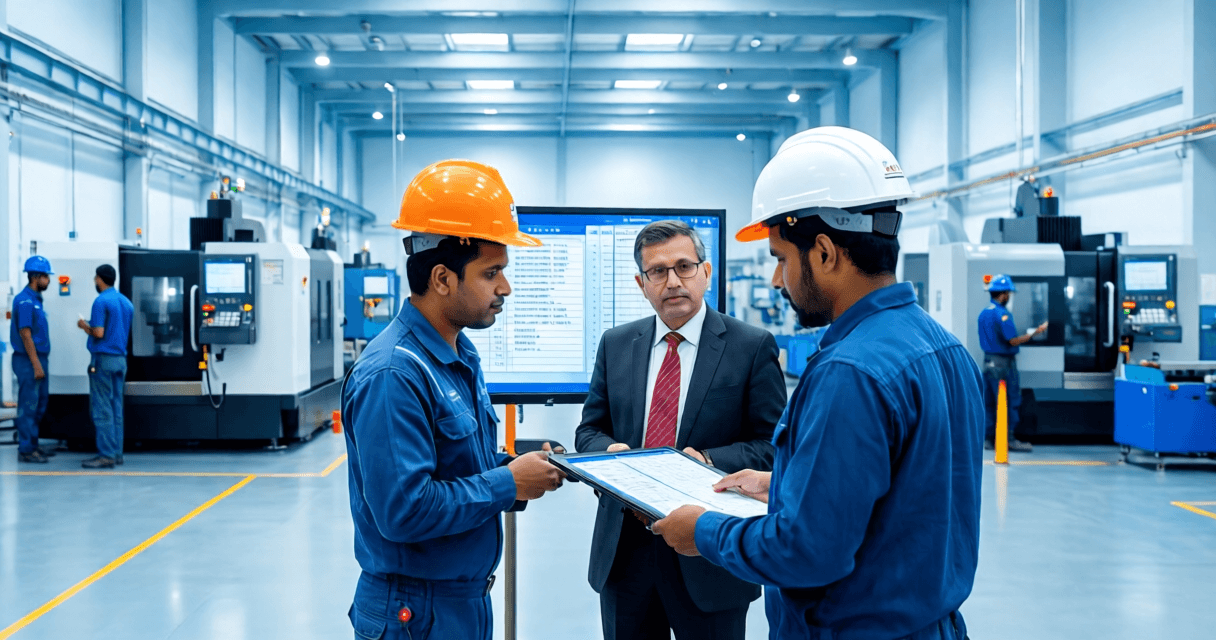

how to choose industrial machinery repair service Hyderabad check
Factory downtime costs lakhs per hour. Learn how how to choose industrial machinery gets resolved fast. MachineryFix connects you with verified technicians via Intelligent Dispatch.

MachineryFix Team
Industrial Repair & Maintenance Experts · 21 September 2026
Need this fixed?
Certified technicians, dispatched from our Hyderabad hub.
# How to Choose Industrial Machinery Repair Service Hyderabad Check
₹5 lakh. That is the production value a single Uppal CNC workshop bleeds in the first hour after an unplanned spindle failure — before the overtime premium on the next shift, the expedited freight on the delayed customer order, and the credibility damage to the OEM account that sourced the work. For plant managers operating across Hyderabad's manufacturing belt, the question of how to choose industrial machinery repair service is not a procurement exercise you table for the next quarterly review. It is a survival decision made in the first ten minutes of a breakdown, with the machine cooling down and the shift clock running. Voltage sags on the SEC feeder, monsoon humidity corroding hydraulic seals in a Sanathnagar packaging unit, fine silica dust from the new SEZ corridor construction working its way into servo drives in Patancheru — these are not edge cases. They are Tuesday afternoons in Kattedan, Balanagar, and Jeedimetla. The difference between a four-hour recovery and a three-day shutdown almost always comes down to one variable: the quality, speed, and transparency of the repair partner standing at your factory gate. This guide walks through every decision point a maintenance head must evaluate before signing off on a service call, using the operational realities of Telangana's industrial clusters as the reference frame.
Understanding the Failure
Misdiagnosis is the single most expensive error in industrial repair, and it happens more often than any plant manager wants to admit. A hydraulic press in a Sanathnagar packaging unit that will not build pressure is a fundamentally different problem from a CNC lathe in Patancheru throwing a servo axis error code. The first classification step separates mechanical failure (bearing seizure, gear tooth fracture, belt slippage) from electrical or electronic failure (VFD tripping, PCB burnout, sensor drift) from hydraulic or pneumatic failure (seal extrusion, pump cavitation, solenoid coil open-circuit). Each category demands a different skill set, a different parts inventory, and a different diagnostic toolkit. An ITI-certified fitter with twelve years on a lathe line can diagnose a bearing seizure by ear. That same fitter will misread a VFD fault code as a motor problem and send you down a ₹80,000 replacement path when the actual fix is a ₹2,200 IGBT module.
In Hyderabad's MSME context, the most common misdiagnosis on the floor is treating an electrical fault as mechanical. A compressor in Nacharam IDA trips its overload relay, and the workshop installs a new motor. Forty-eight hours later it trips again, because the root cause was a failing contactor coil that nobody checked. That single misstep costs the plant two full shifts and roughly ₹1.2 lakh in lost throughput. The second classification step is severity grading. Is the machine stopped and safe to leave? Is it in a partial-failure state where it will complete the current batch but cannot start the next? Is it in a cascading failure mode where a secondary component — a cooling fan, a lubrication pump — is about to fail and will convert a manageable repair into a catastrophic one?
A practical screening protocol for any maintenance engineer on the floor:
- Record the exact error code or fault symptom, photograph the HMI or control panel display
- Note the ambient conditions at the time of failure — temperature, humidity, any recent voltage sag on the 3-phase supply
- Check the last three service entries in your log to see whether a related component was already flagged
- Isolate the affected subsystem before any further production attempts, to prevent collateral damage
This thirty-minute triage is not optional. It is the information set that determines whether the technician arriving at your gate in Kattedan or Cherlapally can resolve the issue in one visit or must return the next day with a different parts kit. The MachineryFix platform is built around this exact logic — its Intelligent Dispatch Engine does not simply send the nearest technician. It cross-references the fault description, machine make, and required skill domain against the Vetted Technician Network before a single vehicle is dispatched. That distinction saves an average of 2.3 hours per incident compared to a generic "send someone" approach, and it means the technician who walks through your gate in Balanagar carries the right pressure transducer, not a generic toolkit.
Immediate Response Steps
The first two hours after a breakdown are where the most money is lost, not because the repair is complex, but because the response is unstructured. In a typical 200-employee MSME in Bollaram or Secunderabad, the chain of communication runs: operator → shift supervisor → maintenance engineer → plant manager → outside vendor. By the time the vendor's phone is picked up, ninety minutes have evaporated. The immediate response protocol should compress that chain to under fifteen minutes.
Step one: Contain and document. Shut down the affected machine safely. If it is a hydraulic press, relieve system pressure and lock out the power supply. If it is a CNC machine, park the tool at a safe position and engage the axis brakes. Photograph the fault state. Note the time, the operator's account, and the last successful cycle. This documentation becomes part of the Digital Service Catalogue record, which matters enormously when you are preparing for an ISO 9001 or ISO 14001 audit. A plant manager in Cherlapally told us that the structured digital service logs from MachineryFix turned their annual audit preparation from a two-week scramble into a one-day file export. That is the kind of operational clarity that should drive your response habits from the first minute.
Step two: Activate your emergency contact within five minutes. If you have a pre-identified on-demand repair partner, call or WhatsApp them now. Do not wait for a second opinion. Do not call three vendors in parallel and hope the cheapest one arrives first. The 24/7 emergency support line matters precisely because breakdowns do not respect your 9-to-5. A compressor failure at 11:40 PM on a Friday in Jeedimetla will not wait until Monday morning. The emergency contact for MachineryFix's 24/7 support is +91 70133 33007 on WhatsApp or call. Describe the machine, the fault, the cluster location, and the severity grade you assigned in the triage phase. The dispatch engine activates within minutes, not hours.
Step three: Protect the remaining production line. If the failed machine is one of three in a series, reroute the work. If it is the only unit, activate your contingency batch plan. The cost of an hour of downtime is not just the lost units — it is the overtime premium on the next shift, the expedited freight on the delayed customer order, and the credibility damage to the account manager at the OEM or brand that sourced the work. In a textile cluster like VNR Textiles' Balanagar unit, a single press-line halt cascades through the dyeing schedule, the finishing queue, and the dispatch calendar.
Step four: Verify the technician at the gate. When the service vehicle arrives, confirm the technician's identity against the dispatch record. Identity-verified technicians are not a marketing phrase; they are a safety requirement when a 200-kilogram press or a live electrical panel is involved. The mutual rating system that follows the job ensures accountability in both directions. The factory rates the technician on punctuality, diagnostic accuracy, workmanship, and cleanliness. The technician rates the factory on access, information quality, and payment timeliness.
> MSME factory owners across India use machineryfix.in to book experienced engineers and technicians with upfront pricing and digital job cards — all from a phone.
Common Root Causes
Five root causes drive the majority of repeat breakdowns across Hyderabad's manufacturing clusters, and none of them are random. After resolving the immediate failure, the maintenance engineer must ask the harder question: why did this happen, and why did it happen here, in this climate, on this machine, at this time? Across the 14 industry verticals MachineryFix covers — from CNC machines and hydraulic presses to textile looms and conveyor systems — the same patterns repeat.
Voltage instability and power quality. Telangana's industrial feeders, particularly in the outer clusters like Patancheru and Sanathnagar, experience voltage sags of 10 to 15 percent during peak summer months when the ambient temperature exceeds 42 degrees Celsius. Variable frequency drives, servo amplifiers, and PLC logic modules carry a ±10 percent tolerance rating. Push them beyond that for weeks, and the electrolytic capacitors degrade, the IGBT modules develop micro-cracks, and the failure is not a surprise — it is a countdown. A CNC service MSME in Uppal lost three spindle drives in one monsoon season before installing a line-rated voltage stabiliser. The stabiliser cost less than a single replacement drive. In tier-2 feeder zones around the Hyderabad ring road, 3-phase supply quality is the silent killer of electronic components, and most plant managers do not even measure it.
Contamination ingress. The Deccan plateau dust, combined with the fine silica particulate from construction activity around the new SEZ corridors, works its way into gearboxes, air filters, and hydraulic reservoirs. In a textile machine at VNR Textiles' Balanagar unit, a 40-micron particulate load in the hydraulic oil caused a proportional valve to stick, which triggered a repeated clamping failure that the operator had been "managing around" for six weeks before the cylinder rod scored and the entire clamp assembly needed replacement. The valve cost ₹18,000. The scored rod and the six weeks of off-spec output cost the unit roughly ₹2.4 lakh.
Lubrication neglect under production pressure. The Make in India push has kept many MSME lines running at 95 percent utilisation. Scheduled lubrication intervals get compressed, skipped, or performed with the wrong viscosity grade. Bearing failures in lathe spindles and conveyor rollers are, in the vast majority of cases, lubrication failures in disguise. A diploma-level technician who has run a lathe for fifteen years will tell you the bearing was "running hot" for three weeks before it seized. The grease had been changed with the wrong ISO grade — 68 instead of 68 — and the thermal breakdown of the additive package did the rest.
Thermal cycling and monsoon humidity. The transition from the 40-degree dry summer to the 30-degree, 85-percent-humidity monsoon creates a thermal and moisture shock cycle that corrodes electrical terminals, degrades potting compounds in PCBs, and causes condensation inside control cabinets. A welding equipment repair in Secunderabad traced a recurring inverter shutdown to moisture bridging a secondary relay contact — a ₹3,000 relay that had been failing intermittently for two months. The fix was a dehumidifier in the control room and a re-solder of two terminal blocks. Total cost: under ₹8,000. The two months of intermittent downtime had cost the workshop an estimated ₹1.8 lakh in rejected welds and rework.
Operator handling and procedural drift. In smaller units with 15 to 60 employees, the same operator often runs the machine, performs basic maintenance, and reports the fault. Procedural drift is inevitable without structured training. The Digital Service Catalogue in the MachineryFix system creates an auditable trail of what was done, when, and by whom, which closes the loop that informal note-keeping and a crumpled entry in a carbon-copy register cannot.
Preventive Actions
Reactive repair is a cost centre. Preventive maintenance is an investment. The economics are not close. A hydraulic press that receives a scheduled seal replacement, fluid analysis, and valve calibration every 1,200 operating hours will outlast the same press on a run-to-failure regime by a factor of two to three, with 60 percent lower lifetime repair spend. The challenge for a plant manager in a 40-employee unit in Kattedan is not knowing this. It is finding the time, the budget approval, and a service partner who will actually perform the preventive work to a documented standard rather than just "having a look" and charging a diagnostic fee.
Predictive Maintenance AMC. This is where a structured annual contract changes the operational model. Under MachineryFix's Predictive Maintenance AMC, a certified technician visits on a fixed schedule — monthly, quarterly, or semi-annually depending on machine criticality — and performs a defined checklist: vibration analysis on rotating assemblies, thermographic scan of electrical connections, hydraulic fluid sampling, lubrication top-up with the correct ISO grade, and a written condition report uploaded to the Digital Service Catalogue. The factory gets a rolling health index for every asset. When a bearing's vibration signature starts trending upward at 3.2 mm/s instead of the normal 1.1 mm/s, the AMC technician flags it before it becomes a seizure. The plant manager gets a 14-day window to schedule the replacement during a planned weekend shutdown instead of a 2 AM emergency call on a Thursday. In a compressor-heavy cluster like Nacharam IDA, where a single air-end failure halts the entire production line, that 14-day window is the difference between a controlled maintenance window and a full-line stoppage.
Parts inventory strategy. For high-wear items — hydraulic seals, V-belts, bearing kits, filter elements — maintain a minimum 90-day stock on the factory shelf. The cost of a sealed hydraulic kit is a fraction of the ₹2 lakh to ₹4 lakh in lost production from a single-day shutdown waiting for a courier delivery from Pune or Chennai. In the monsoon months, when road connectivity between industrial clusters degrades and courier transit times stretch from two days to five, that shelf stock is not a luxury. It is the only thing standing between a four-hour repair and a three-day halt.
Environmental controls. A ₹15,000 air-conditioning unit for the electrical control room, a proper dust barrier
Published on
India's on-demand industrial repair platform — certified technicians dispatched fast.
Frequently Asked Questions
How do I get a technician for how to choose industrial machinery in Hyderabad?
MachineryFix's Intelligent Dispatch Engine matches your breakdown with the nearest verified technician in Hyderabad. Available 24/7 for emergency support. Book at machineryfix.com or WhatsApp +91 70133 33007.
Are MachineryFix technicians verified and experienced?
Yes. Every technician on MachineryFix is an experienced engineer or technician, passing rigorous skill evaluation before being onboarded. This is why MachineryFix maintains a 4.8/5 average rating from factory clients across India.
What is a Predictive Maintenance AMC and how does it work?
A Predictive Maintenance AMC (Annual Maintenance Contract) from MachineryFix covers scheduled inspections, condition monitoring, and priority emergency response. It reduces unplanned breakdowns by 40-60% and is ideal for factories running critical CNC, hydraulic, or textile machines.
How much does industrial machine repair cost in India?
Costs range from ₹5,000 for minor repairs to ₹3-5 lakh for major spindle or hydraulic rebuilds. MachineryFix uses competitive bidding — you receive upfront proposals from multiple local experts before committing, so you always get a fair price.
What documentation does MachineryFix provide after a repair?
MachineryFix generates a Digital Service Catalogue entry for every job — logging the fault, diagnosis, parts replaced, technician ID, and timestamps. This digital job card is accepted for ISO 9001 and GMP compliance audits.
Can I rehire the same technician for future jobs or an AMC?
Yes. MachineryFix's re-hiring feature lets you save a preferred technician directly to your account. You can rebook them for follow-up work, recurring maintenance, or a full AMC contract — keeping your factory history consistent.
Need a certified technician?
Get one dispatched fast.