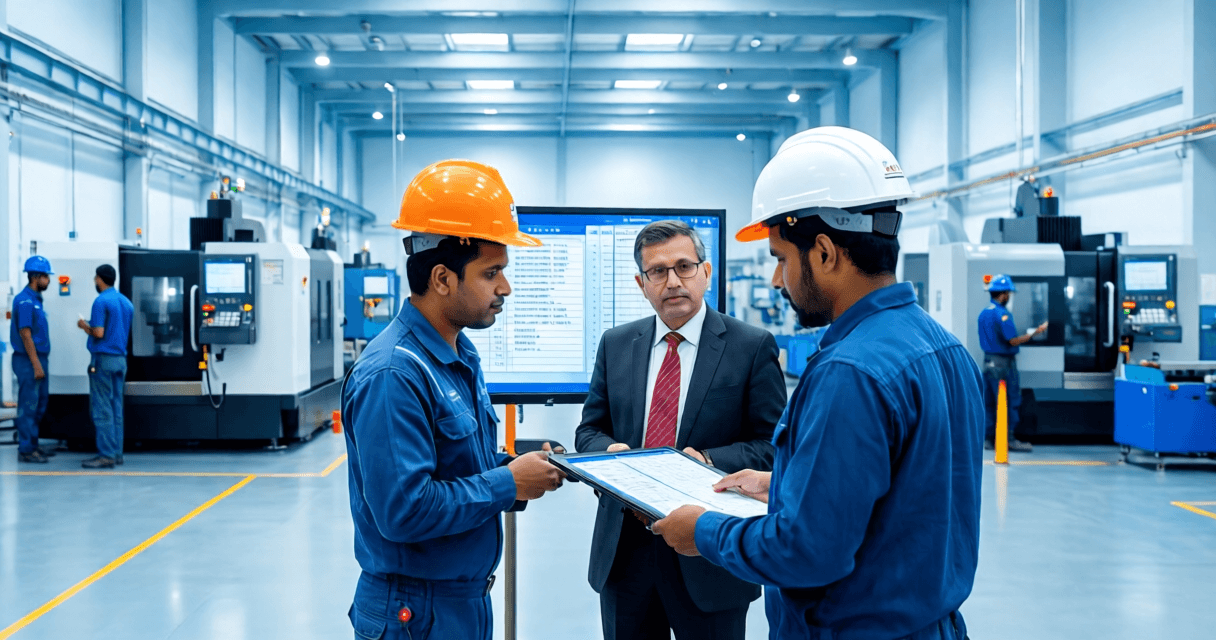

industrial machinery AMC annual maintenance contract Hyderabad fa
Factory downtime costs lakhs per hour. Learn how industrial machinery AMC annual mai gets resolved fast. MachineryFix connects you with verified technicians via Intelligent Dispatch.

MachineryFix Team
Industrial Repair & Maintenance Experts · 20 September 2026
Need this fixed?
Certified technicians, dispatched from our Hyderabad hub.
Every hour of unplanned downtime at an Indian manufacturing plant burns between ₹50,000 and ₹5,00,000 in lost output, scrapped material, and idle wages. For a 200-worker unit in Uppal or Kattedan, that single hour wipes out a full week's margin before the first shift of the next day even starts. An industrial machinery AMC annual maintenance contract is no longer a line item to negotiate in Q4. It is the difference between a factory that ships on time and one that is perpetually apologising to its customers. And yet the dominant operating model across Telangana's MSME corridor remains break-fix: wait for the spindle to seize, then scroll through a WhatsApp group asking, "Who knows a guy who fixes hydraulic presses?" The outcome is predictable. Weeks of lost throughput. Premium pricing from whoever happens to answer the phone. Zero documentation when the ISO auditor walks in six months later.
The MachineryFix platform exists to collapse that scramble into a two-minute dispatch. Its Intelligent Dispatch Engine cross-references the specific fault code, machine type, and required skill set against the real-time location of every certified technician in the network. A hydraulic press failure in Kattedan gets routed to the nearest verified hydraulic specialist, not a general fitter who has never opened a pressure accumulator. The plant manager sees the name, the rating, the distance, and the ETA before accepting. The technician arrives with the right parts, verifies identity at the gate, and the machine is back in the cycle.
Understanding the Failure
A machine breakdown is the last visible event in a chain that started weeks earlier. In a CNC machining unit in Kattedan Industrial Area, a spindle bearing failure that halted the line for 14 hours was traced, through Digital Service Catalogues records, to a coolant pump seal leaking micro-drops for six consecutive weeks. Those drops corroded the bearing race. The bearing overheated. The spindle seized. The entire line went dark. The seal was a ₹400 part. The downtime cost exceeded ₹3,00,000.
This cascade repeats across Indian manufacturing with almost mechanical regularity. A 200-worker textile mill in Balanagar Industrial Zone loses 40 hours a month to intermittent stoppages on its ring frame. A rotary compressor in a packaging plant at Nacharam IDA trips on overload three times a week, each trip resetting the production schedule. A hydraulic press in Sanathnagar develops a slow oil leak that the operator ignores for two months before the pressure drops below safe operating range and the cylinder sticks mid-stroke, requiring a full teardown. In every case, the signal was present in vibration, in oil discoloration, in the faint whine the bearing made at 2 AM when the night shift was thin on staff.
The Hyderabad manufacturing corridor carries a specific compounding risk: power-quality instability. Even in IDA and MIDC zones where the T&D supply is nominally stable, a 10% voltage sag lasting 8 to 12 seconds is enough to reset a VFD, corrupt a CNC controller's parameter memory, or push a hydraulic pump's motor winding past its thermal limit. Add monsoon humidity from June through September, and electrical panels in Patancheru and Bollaram factories develop slow corrosion on terminal blocks and relay contacts. Red-soil dust from the compound roads accelerates wear on air filters, encoder housings, and sensor arrays. The machine does not fail on a schedule. It fails on the day the humidity hits 92% and the voltage dips during the 4 PM peak load.
Treating every breakdown as an emergency is the wrong frame. Treating every anomaly as a data point is the right one. The question a plant manager should be asking is not "Why did the machine stop?" It is "Why did no one flag the anomaly three weeks ago?" That shift in diagnostic thinking is where a structured industrial machinery AMC annual maintenance contract earns its fee.
Immediate Response Steps
The first 30 minutes after a machine stops determine whether the repair takes 2 hours or 2 days. A plant manager in Secunderabad or Jeedimetla should act in this sequence, without exception:
- Stop the feed, isolate the energy source, and tag the machine. Lockout-tagout is non-negotiable. In a hydraulic press unit at a Jeedimetla cluster factory, an operator who tried to "just nudge the ram" while the accumulator was still charged lost two fingers. Production pressure does not override safety protocol. Not once. Not under deadline.
- Document the failure state before anyone touches a wrench. Photograph the error code on the HMI screen, the physical damage, the oil level, the filter condition. Note the time, the ambient temperature, the load the machine was carrying when it stopped. This is the diagnostic data a competent technician needs to begin troubleshooting remotely before even reaching the factory gate.
- Do not call the first number that comes to mind. In the old model, a maintenance head in Cherlapally would call a cousin's friend who "knows a guy who fixes lathes." That guy might be brilliant, or he might be a general fitter with a socket set and no training on your specific FANUC or Siemens controller. You have no way to verify skill, identity, or past work history.
- Call a verified, dispatchable expert with a tracked ETA. This is where 24/7 emergency support changes the outcome. A plant manager at Kattedan described the difference between "I will call someone, he might come tomorrow" and "a verified hydraulic expert is 22 minutes away, you can see his live location on the app" as the difference between a 4-hour repair and a 2-day shutdown. The first scenario costs ₹2,00,000. The second costs ₹12,00,000.
If your factory does not yet have a standing AMC, the fastest path to a qualified technician is a single WhatsApp message to +91 70133 33007. Describe the machine make, the symptom, the error code, and your location. The Intelligent Dispatch Engine cross-references that breakdown against the Vetted Technician Network and returns matching experts with their proximity, skill certification, and availability within minutes. You compare bids, you pick, and the technician is en route. No phone tag. No "let me check with my partner." No 6-hour wait while someone drives from Medchal to see if the part is in stock.
> MSME factory owners across India use machineryfix.in to book experienced engineers and technicians with upfront pricing and digital job cards — all from a phone.
Common Root Causes
After reviewing thousands of service logs across the 14 industry verticals MachineryFix covers, five root causes account for the overwhelming majority of unplanned breakdowns in Indian MSME factories:
- Electrical and power-quality degradation. Voltage sags, phase imbalance, and harmonic distortion from neighbouring heavy loads in the same IDA block degrade VFDs, contactors, and PLC inputs over months. A compressor in a Bollaram packaging plant ran its motor 8% over rated current for four months before the winding insulation failed and the unit required a full motor replacement at ₹1,80,000. The root cause was a 3-phase imbalance that the plant's electrician had noted in a handwritten maintenance log in February but never corrected. The log was found in a drawer during the repair.
- Lubrication and contamination failure. Dust from the compound, monsoon moisture, and inconsistent oil-change schedules are the trinity that kills bearings, cylinders, and gearboxes. In a textile mill in Patancheru, a ring-frame spindle bearing failed because the oil had not been changed in 11 months against a recommended 6-month interval. The saved cost on oil was roughly ₹3,000. The lost production, the emergency bearing replacement, and the 9-hour line stoppage cost over ₹2,00,000.
- Wear-part neglect. Belts, seals, gaskets, and filter elements have finite service lives. Indian factories routinely run these parts past their rated life because replacement requires a short shutdown and the operator says, "It is still fine, I can hear it." It is fine until it is not, and the replacement then requires a full teardown rather than a 20-minute swap.
- Operator training gaps. A skilled-labour shortage means a 22-year-old ITI graduate is running a 15-year-old CNC machine because the trained operator left for a higher-paying role in Pune or Nashik. Incorrect feed rates, wrong tool selection, and ignored warning lights compound over weeks into a catastrophic failure. The machine is not broken. It is being misused.
- Absence of structured maintenance records. Without a digital log, the plant manager cannot see that the same bearing has been replaced three times in 18 months, which would point to a shaft misalignment or a load issue rather than a bearing defect. The fourth replacement is not a bearing problem. It is a geometry problem. But without the record, no one connects the dots.
Every one of these root causes is preventable. Every one is also invisible without a system that tracks, flags, and escalates anomalies before they become failures. That system is the industrial machinery AMC annual maintenance contract, and it must be more than a calendar reminder to "grease the bearings in March."
Preventive Actions
A well-structured AMC is a production-continuity insurance policy, not a cost centre. For a manufacturing unit in the Hyderabad corridor, a preventive maintenance programme should operate on this cadence:
- Monthly condition inspections with digital documentation. A certified technician visits, checks vibration levels on critical bearings, runs thermal imaging on electrical panels and VFDs, samples hydraulic oil for particle count and water content, and measures belt tension on conveyors. Every finding is logged in the Digital Service Catalogue with photos, measurements, and a severity rating. The plant manager sees this on their phone during the 11 AM production meeting, not on a crumpled paper slip tucked behind the panel in the maintenance room.
- Quarterly deep-service interventions. Scheduled bearing replacement, coolant system flush, VFD capacitor bank check, hydraulic filter swap, and controller parameter backup. These are done before the part reaches end-of-life, not after. The technician carries OEM-grade or certified-equivalent parts in the van, so there is no 3-day wait for a spare to arrive from a trader in Secunderabad's Charampeta market.
- Annual performance benchmarking. The AMC engineer compares this year's machine output, cycle time, and energy consumption against last year's baseline. If a CNC mill in Uppal is running 12% slower than its rated cycle time, the root cause is identified and corrected during the next scheduled visit, before it becomes a full stoppage that halts the entire cell.
- Predictive alerts. The Predictive Maintenance AMC module tracks cumulative operating hours, vibration trends, and thermal signatures across the machine's life. When a pattern deviates from the machine's historical norm, the system flags it and the plant manager receives a notification: "Bearing temperature on spindle 2 is trending 15% above baseline. Recommended intervention within 10 days." The intervention is scheduled during a planned changeover, not at 11 PM on a Thursday.
A plant manager at Balanagar Industrial Zone reported that after switching to a structured AMC, his press line turnaround improved dramatically. He no longer spends Sunday nights calling around for a technician who "might be free on Monday." The work is already scheduled, the parts are already ordered, and the Digital Service Catalogue gives his quality team a clean, timestamped audit trail for ISO 9001 certification. That documentation alone, as one manager in Cherlapally noted during a conversation over chai in the factory canteen, saved him from a non-conformance finding during his last external audit. The auditor asked for the bearing replacement history. The manager opened his phone and showed 14 months of logged entries with photos, part numbers, and technician IDs. The finding was withdrawn on the spot.
How MachineryFix Helps
The gap between "we know we need an AMC" and "we actually have one that functions" is where most Indian MSME factories get stuck. The traditional AMC model in India is a paper contract with a name on it. The technician visits twice a year, signs a sheet in a register, and the plant manager hopes for the best. When the machine breaks at 11 PM on a Thursday, the "AMC" means nothing because there is no dispatch mechanism, no verified pool of specialists, and no accountability beyond a phone number that goes to voicemail.
MachineryFix operates on a different architecture, built for how Indian factories actually run:
- Intelligent Dispatch Engine. When a breakdown occurs, the algorithm matches the specific machine type, the fault code, the required skill set, and the technician's real-time GPS location. A hydraulic press failure in Kattedan is routed to the nearest certified hydraulic specialist, not a general electrician who "knows a bit about pneumatics." The match happens in under two minutes. The plant manager sees the technician's name, rating, distance, and ETA before accepting the job.
- Competitive bidding. For non-emergency repairs, the factory receives multiple proposals with upfront pricing and part breakdowns. A manager at Jeedimetla Cluster saved 20% on a gearbox overhaul by comparing three bids side by side on the app. No haggling in the yard. No "the price will be more once I see the damage." The number is the number.
- Vetted Technician Network. Every engineer and technician on the platform passes identity verification, a written skill evaluation, and a practical assessment on a live machine before their first assignment. The 4.8/5 average rating across thousands of completed jobs is the aggregate of a two-way feedback system where the factory rates the technician and the technician rates the job access and parts availability. Both scores are visible.
- Digital Service Catalogues. Every repair, every part replaced, every diagnostic reading is stored in a structured, timestamped digital log. For a factory preparing for an ISO audit, a BIS compliance check, or a customer quality review, this log is the evidence. The quality manager does not reconstruct 18 months of bearing history from memory and a stained notebook.
- Re-hiring and AMC continuity. If a technician fixed your CNC machine brilliantly, you rehire them directly for the next job or lock them into your Predictive Maintenance AMC. The relationship is not reset every time. The technician knows your machine, your tolerances, your quirks, and the specific way your coolant system behaves in August humidity.
All communication, bidding, and payment stays inside the app. No personal phone numbers exchanged in the yard. No cash transactions with no receipt. The factory manager's WhatsApp number is protected. The technician receives weekly payouts with full transaction transparency. Both sides operate with a record that holds up under scrutiny.
Why MachineryFix Is India's Fastest Repair Network
Speed in industrial repair is not about one person driving fast. It is about eliminating every layer of friction between "the machine is down" and "a qualified expert is at your gate with the right parts in hand." In the traditional Indian repair ecosystem, that friction is enormous. You call a number. They call their partner. The partner checks if he is busy. If he is not busy, he drives 40 minutes, arrives, looks at the machine, says "I need to order a part," leaves, and calls back in three days. Three days. At ₹50,000 per hour of lost production, that is ₹12,00,000 evaporated into the atmosphere of a factory that is now behind schedule with three customers.
MachineryFix compresses that timeline to minutes. The Intelligent Dispatch Engine has already matched the fault to the nearest certified expert. The Digital Service Catalogue has already flagged the likely part based on the machine's service history. The competitive bidding process has already locked the price before the technician reaches the gate. The technician is en route, and the plant manager can see his live location from a phone in the office. He arrives, his identity is verified at the factory gate, he diagnoses, he repairs with OEM-grade parts, and the plant manager approves the digital job card before any payment is released. The entire cycle, for a standard repair, runs 3 to 6 hours from breakdown to machine back in production.
This is the operating model for factories in Uppal, Kattedan, Balanagar, Jeedimetla, Cherlapally, Secunderabad, Patancheru, Nacharam IDA, Bollaram, and Sanathnagar. It is the model that keeps a textile mill's ring frames running through the monsoon season when humidity is eating into every servo drive. It is the model that keeps a packaging unit's compressor line online during peak demand when the customer is waiting for a 48-hour delivery. It is the model that protects a CNC shop's 40-hour weekly output target when the spindle bearing is trending hot and the next job is already loaded in the queue.
A factory in Hyderabad or anywhere in Telangana that is still relying on a phone book, a WhatsApp group, and a prayer to keep its machines running is paying for that gamble in lakhs every single month. A structured industrial machinery AMC annual maintenance contract, backed by a verified technician network and a dispatch engine that resolves a match in under two minutes, is the highest-ROI decision a plant manager can make this quarter. Not next quarter. This one.
Book a Technician now at [machineryfix.com/#book](https://machineryfix.com/#book) or WhatsApp +91 70133 33007. Describe your machine, your symptom, your error code, and your location. In under two minutes, you will have a verified expert's name, a live ETA on your phone, and a transparent price before anyone picks up a wrench. Your production line does not have to wait another day.
Published on
India's on-demand industrial repair platform — certified technicians dispatched fast.
Frequently Asked Questions
How do I get a technician for industrial machinery AMC annual mai in Hyderabad?
MachineryFix's Intelligent Dispatch Engine matches your breakdown with the nearest verified technician in Hyderabad. Available 24/7 for emergency support. Book at machineryfix.com or WhatsApp +91 70133 33007.
Are MachineryFix technicians verified and experienced?
Yes. Every technician on MachineryFix is an experienced engineer or technician, passing rigorous skill evaluation before being onboarded. This is why MachineryFix maintains a 4.8/5 average rating from factory clients across India.
What is a Predictive Maintenance AMC and how does it work?
A Predictive Maintenance AMC (Annual Maintenance Contract) from MachineryFix covers scheduled inspections, condition monitoring, and priority emergency response. It reduces unplanned breakdowns by 40-60% and is ideal for factories running critical CNC, hydraulic, or textile machines.
How much does industrial machine repair cost in India?
Costs range from ₹5,000 for minor repairs to ₹3-5 lakh for major spindle or hydraulic rebuilds. MachineryFix uses competitive bidding — you receive upfront proposals from multiple local experts before committing, so you always get a fair price.
What documentation does MachineryFix provide after a repair?
MachineryFix generates a Digital Service Catalogue entry for every job — logging the fault, diagnosis, parts replaced, technician ID, and timestamps. This digital job card is accepted for ISO 9001 and GMP compliance audits.
Can I rehire the same technician for future jobs or an AMC?
Yes. MachineryFix's re-hiring feature lets you save a preferred technician directly to your account. You can rebook them for follow-up work, recurring maintenance, or a full AMC contract — keeping your factory history consistent.
Need a certified technician?
Get one dispatched fast.