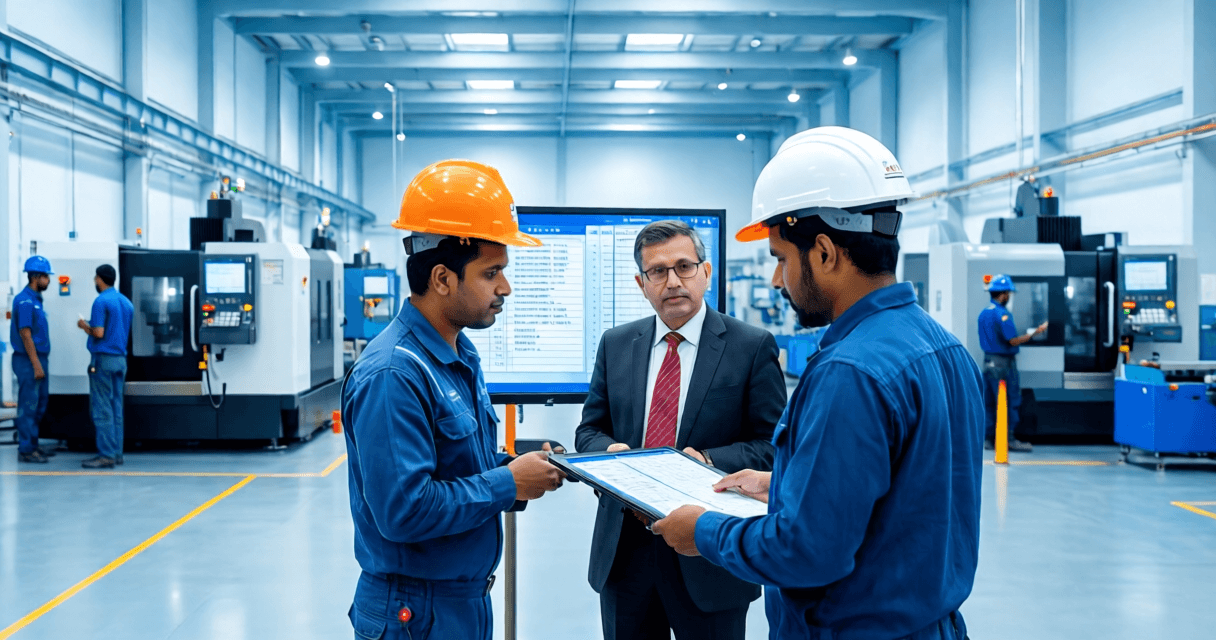

industrial machinery AMC annual maintenance contract Hyderabad fa
Factory downtime costs lakhs per hour. Learn how industrial machinery AMC annual mai gets resolved fast. MachineryFix connects you with verified technicians via Intelligent Dispatch.

MachineryFix Team
Industrial Repair & Maintenance Experts · 6 October 2026
Need this fixed?
Certified technicians, dispatched from our Hyderabad hub.
A single hour of unplanned downtime in a Hyderabad manufacturing unit burns through ₹50,000 to ₹5 lakh in lost production, overtime premiums, and client penalty clauses. For the 40,000-plus MSME factories operating across Telangana's industrial corridors, that figure is not a theoretical risk. It is a Tuesday afternoon reality. That is why a structured industrial machinery AMC annual mai (annual maintenance contract) is no longer optional for plant managers in Uppal, Kattedan, or Balanagar. It is the line between a 20-minute corrective repair and a 48-hour shutdown that erases a full week's revenue before the finance team even posts the entry.
Understanding the Failure
Walk the shop floor at any CNC unit in Nacharam IDA or a hydraulic press line in Kattedan Industrial Area, and you will hear the same story repeated by maintenance engineers: the machine ran fine on Monday, and by Wednesday morning the spindle is throwing E-code 412, the servo drive is overheating, or the hydraulic manifold has developed a slow leak that nobody noticed until the pressure gauge read 4 bar below spec. Failures in Hyderabad's manufacturing belt rarely announce themselves with a single dramatic event. They accumulate. A bearing runs 800 hours past its service interval. A coolant pump's impeller loses 2 millimetres of clearance. A control cabinet's IP rating degrades as fine dust from the adjacent grinding shop settles on the PCB traces.
The financial mechanics are brutal. A CNC machining centre running a 3-shift schedule at 14,000 RPM spindle speed produces roughly ₹18,000 to ₹25,000 in billable output per hour. When that machine stops for a spindle bearing replacement that requires a 6-hour teardown, re-alignment, and a 2-hour test cycle, you are looking at ₹1,00,000 to ₹1,40,000 in direct lost output for a single incident. Multiply that by the two or three times per quarter that an unmanaged factory experiences unplanned stoppages, and the annual downtime cost for a mid-size MSME in Sanathnagar easily crosses ₹8 lakh to ₹12 lakh.
The compounding factor that most Indian plant managers underestimate is the secondary cascade. When a critical machine goes down, the upstream material handlers stop, the downstream packaging line idles, and the quality inspection bench sits empty. Overtime is called for the next two shifts to recover the backlog, which inflates labour costs by 40 to 60 percent. If the delay pushes a delivery past the client's SLA window, penalty clauses kick in. One factory manager in Jeedimetla Cluster told us that a single compressor failure on a Friday afternoon cost him ₹3.2 lakh in combined lost output, overtime, and a client penalty of ₹45,000.
This is the failure that a proper industrial machinery AMC annual mai programme is designed to intercept before it reaches the shop floor.
Immediate Response Steps
The first 15 minutes after a machine stops determine whether the repair takes two hours or two days. A disciplined plant manager in Patancheru or Secunderabad should execute the following before anyone picks up a wrench.
- Isolate and lock out. Engage the machine's emergency stop, disconnect the main isolator, and apply a visible lockout tag. In a voltage-fluctuation event common during Hyderabad's summer peaks, a partially energised drive can re-engage and injure a technician mid-diagnosis.
- Capture the error state. Photograph the HMI screen, note the exact error code, and record the last known operating parameters — spindle speed, feed rate, hydraulic pressure, current draw. If the controller has a data logger, export the last 30 minutes of runtime data. This single step can cut diagnostic time by 40 percent when the repair technician arrives.
- Document the physical state. Take photos of any visible damage: a cracked coupling, a burnt-smell indicator, oil pooling under the bed plate, a swollen capacitor on the inverter board. Note the ambient temperature and humidity in the machine bay. Hyderabad's monsoon season pushes relative humidity past 85 percent, and that moisture in a control cabinet is a leading cause of intermittent faults.
- Call the right person, not the nearest person. This is where most MSME factories lose time. They call the last technician who fixed the machine, who is 90 kilometres away in Warangal, and wait. A structured on-demand repair workflow instead dispatches a verified expert who is already within a 15-kilometre radius and carries the specific OEM-grade parts for your machine class.
- Escalate on a timer. If the machine is not running within 4 hours, escalate to your production head and client liaison simultaneously. Do not wait for the repair to be complete before informing stakeholders.
For a 24/7 emergency line, Hyderabad factory owners can reach out on WhatsApp at +91 70133 33007 and describe the breakdown with the error code and machine make. The response is not a call centre reading from a script. It is a triage engineer who has handled CNC spindles, hydraulic manifolds, and compressor seals before lunch.
> MSME factory owners across India use machineryfix.in to book experienced engineers and technicians with upfront pricing and digital job cards — all from a phone.
Common Root Causes
After analysing thousands of service tickets across Telangana's industrial zones, the failure patterns in Indian MSME manufacturing cluster around a handful of recurring root causes. Understanding them is the first step toward a maintenance programme that actually prevents the next breakdown.
Grid instability and voltage fluctuation remain the number one silent killer. In industrial corridors like Bollaram and Uppal, supply voltage swings between 348 V and 432 V on a regular basis, especially during the 4 PM to 9 PM peak window. A VFD rated for 380 V ± 10 percent will see its IGBT modules degrade 3 to 4 times faster. A capacitor on a welding inverter board will bulge, leak, and eventually short. Most factories in this range do not have an online UPS or a voltage-stabilising transformer, so the machine absorbs every spike.
Monsoon humidity and dust ingress form the second cluster. Telangana's June-to-September monsoon drops ambient humidity to 88 to 94 percent in unconditioned machine bays. For electronics, that means condensation on PCB solder joints, corrosion on relay contacts, and insulation breakdown in motor windings. Dust from grinding, cutting, and sanding operations migrates into open gearboxes and hydraulic accumulators. A factory in Cherlapally reported that 60 percent of their packaging machine faults during monsoon traced back to moisture in the photoelectric sensor array.
The skilled labour shortage is the third and most painful cause. India produces roughly 800,000 engineering graduates per year, but the proportion trained in industrial electromechanics, PLC programming, and hydraulic systems is a small fraction of that. A factory in Balanagar Industrial Zone told us they lost their senior CNC technician to a private-sector job in Pune and had been running on a junior operator for 14 months. Every fault became a guess. Every guess became a 6-hour stoppage.
Deferred maintenance rounds out the list. The temptation to skip a quarterly bearing service because "the machine is still running" is universal. In a 3-shift operation, that bearing has already logged 2,000 additional hours by the time you notice the noise. The next failure is not a question of if, but of when, and the cost of a bearing failure mid-cycle runs 5 to 8 times the cost of a scheduled bearing change.
Preventive Actions
A preventive maintenance programme is the operating system that keeps a Hyderabad manufacturing unit's P&L intact. The following industrial machinery AMC annual mai schedule is calibrated for Indian operating conditions, not copied from a German OEM manual.
- Monthly electrical inspection. Test insulation resistance on all motor windings, check VFD fan operation, inspect cable trays for chafing, and verify that the control cabinet's IP rating has not degraded. In a dust-heavy environment like a grinding shop in Secunderabad, this monthly check catches 70 percent of potential short-circuit events before they become a fire.
- Quarterly mechanical service. Grease all bearing housings, check belt and chain tension, inspect hydraulic hoses for bulging or weeping, and verify that all safety guards and interlocks function correctly. A hydraulic press in Kattedan that skipped one quarterly service lost ₹1.8 lakh when a hose burst during a 300-tonne cycle.
- Semi-annual calibration. For CNC machines, this means a full geometric accuracy check, ball-bar test, and backlash measurement. For compressors, it means a valve seat inspection and a dew-point verification of the aftercooler. These are the checks that keep your part tolerance within spec and your client audit trail clean.
- Annual full overhaul. Strip the machine, inspect every component, replace all wear parts — seals, gaskets, filters, brushes — and re-commission. In a factory that runs 6,000 to 8,000 hours per year, this is not optional.
The key operational shift is moving from reactive repair to predictive intervention. A machine that is monitored, logged, and serviced on a fixed cadence will not surprise you at 2 AM on a Sunday. It will tell you on a Tuesday morning that the spindle bearing's vibration signature has shifted by 12 percent, and you schedule the replacement for the weekend. That is the entire economics of an AMC programme, and it is the difference between a ₹25,000 bearing change and a ₹2,00,000 spindle replacement performed in a panic.
For Indian factory owners who want to move to this model without building an in-house team, the MachineryFix platform connects factories with verified technicians and structured maintenance plans, with live tracking from dispatch to factory gate.
How MachineryFix Helps
The gap between knowing what preventive maintenance looks like on paper and actually executing it across a factory floor in Hyderabad is where most MSME operations lose money. You do not have a 12-person maintenance team. You have one or two technicians who are also your electrician, your fitter, and your forklift driver. You cannot afford to hire a dedicated VFD specialist, a hydraulic systems engineer, and a PLC programmer. That is a ₹45 lakh annual payroll you simply do not have.
MachineryFix's Predictive Maintenance AMC module was built to close that gap. Under the AMC, your factory gets a structured calendar of inspections, service intervals, and parts-replacement milestones tailored to your machine class, operating hours, and environmental conditions. The AMC is not a generic "we will visit once a quarter" agreement. It is a machine-specific maintenance plan built from the Digital Service Catalogues that log every prior repair, every part replaced, and every diagnostic reading. When a technician from the Vetted Technician Network arrives at your unit in Patancheru, they are not starting from zero. They open the machine's full service history on a tablet, see that the hydraulic accumulator was replaced 14 months ago, that the servo drive firmware was updated last quarter, and that the coolant pump impeller is approaching its service interval. The repair or service is targeted, faster, and more accurate.
The Intelligent Dispatch Engine handles the logistics that would otherwise eat your afternoon. You describe the breakdown — machine make, error code, symptoms, your location in Nacharam IDA — and the algorithm matches you with the nearest certified expert who has the specific skill set. You see the technician's name, their verified identity, their rating, and their estimated arrival time before you accept. If you prefer, you can run competitive bidding and compare two or three proposals with upfront pricing before committing. A plant manager at Jeedimetla Cluster reported saving 20 percent on a hydraulic press repair by comparing bids through the platform instead of accepting the first quote.
The Digital Service Catalogues also solve a compliance headache that most Indian factory owners dread: ISO audits. Every job is logged digitally — what was diagnosed, what was replaced, the parts serial numbers, the before-and-after readings. When the auditor asks for your maintenance records for the past 24 months, you export a clean, timestamped log in minutes. "Digital service logs are fantastic for ISO audits," as Anita Desai, a factory manager in Cherlapally, put it.
For the factory that needs a one-off repair rather than a full AMC, the 24/7 emergency support line means that a breakdown at 11 PM on a Saturday does not mean a 24-hour wait for Monday morning. A verified technician is dispatched, arrives with OEM-grade parts, and your line is back up before the shift ends. The platform holds a 4.8/5 average rating across its service network, which is meaningful in a market where the default experience is calling three different numbers, waiting two days, and hoping the technician who finally shows up has the right parts in his van.
Book Your Technician
Your next breakdown is not a matter of if. It is a matter of which shift it hits and how many hours you lose before a qualified pair of hands touches the machine. If your factory in Hyderabad, Secunderabad, Patancheru, or anywhere across Telangana is running on last year's maintenance schedule and a WhatsApp number for "that guy who fixed the lathe," you are one E-code away from a ₹2 lakh afternoon.
Call or WhatsApp +91 70133 33007 right now. Describe the machine, the symptoms, the error code. Get matched with a verified technician within your 15-kilometre radius before the next shift starts. Or walk through the MachineryFix booking page and lock in a Predictive Maintenance AMC that turns your next 12 months of reactive firefighting into a scheduled, logged, audit-ready maintenance calendar. The machine will not fix itself. The question is whether you pay for the repair or you pay for the downtime.
Published on
India's on-demand industrial repair platform — certified technicians dispatched fast.
Frequently Asked Questions
How do I get a technician for industrial machinery AMC annual mai in Hyderabad?
MachineryFix's Intelligent Dispatch Engine matches your breakdown with the nearest verified technician in Hyderabad. Available 24/7 for emergency support. Book at machineryfix.com or WhatsApp +91 70133 33007.
Are MachineryFix technicians verified and experienced?
Yes. Every technician on MachineryFix is an experienced engineer or technician, passing rigorous skill evaluation before being onboarded. This is why MachineryFix maintains a 4.8/5 average rating from factory clients across India.
What is a Predictive Maintenance AMC and how does it work?
A Predictive Maintenance AMC (Annual Maintenance Contract) from MachineryFix covers scheduled inspections, condition monitoring, and priority emergency response. It reduces unplanned breakdowns by 40-60% and is ideal for factories running critical CNC, hydraulic, or textile machines.
How much does industrial machine repair cost in India?
Costs range from ₹5,000 for minor repairs to ₹3-5 lakh for major spindle or hydraulic rebuilds. MachineryFix uses competitive bidding — you receive upfront proposals from multiple local experts before committing, so you always get a fair price.
What documentation does MachineryFix provide after a repair?
MachineryFix generates a Digital Service Catalogue entry for every job — logging the fault, diagnosis, parts replaced, technician ID, and timestamps. This digital job card is accepted for ISO 9001 and GMP compliance audits.
Can I rehire the same technician for future jobs or an AMC?
Yes. MachineryFix's re-hiring feature lets you save a preferred technician directly to your account. You can rebook them for follow-up work, recurring maintenance, or a full AMC contract — keeping your factory history consistent.
Need a certified technician?
Get one dispatched fast.