
on-demand machinery repair vs contract service Hyderabad factory
Factory downtime costs lakhs per hour. Learn how on-demand machinery repair vs contr gets resolved fast. MachineryFix connects you with verified technicians via Intelligent Dispatch.

MachineryFix Team
Industrial Repair & Maintenance Experts · 27 September 2026
Need this fixed?
Certified technicians, dispatched from our Hyderabad hub.
# On-Demand Machinery Repair vs Contract Service: Hyderabad Factory
In a mid-size CNC unit in Uppal Industrial Area, a single spindle bearing failure on a five-axis machine bleeds ₹85,000 to ₹2.5 lakh per hour in lost production, scrap rework, and overtime penalties stacked on top of each other. The machine is back in the production queue in ninety minutes, or it is not. That ninety-minute window is where the on-demand machinery repair vs contract service decision actually lives. For the 30-machine stamping unit in Kattedan, the 12-compressor pharma line in Balanagar, or the packaging shop in Jeedimetla running a 40,000-piece bracket order with a Friday delivery date, the choice between a standing annual contract and a pay-per-incident repair call is not a line item in the finance department. It is the variable that decides whether the order ships or the client calls.
Understanding the Failure
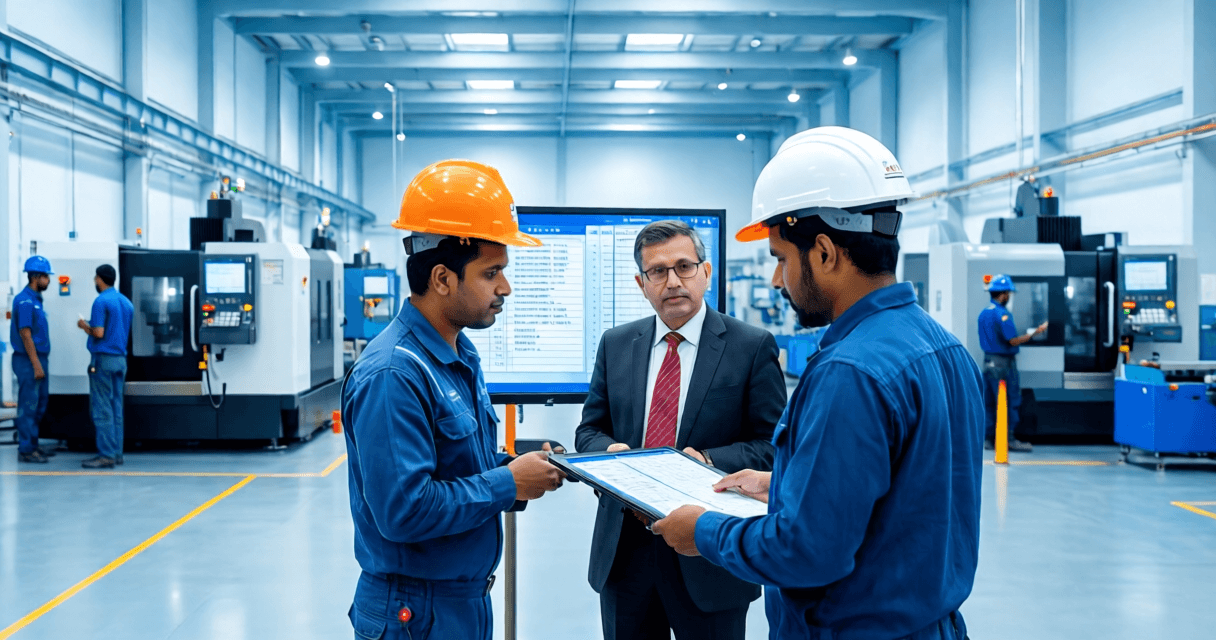
A hydraulic press in a Kattedan Industrial Area stamping unit fails at 11:40 on a Tuesday morning. The operator notices the ram sticking mid-stroke, the pressure gauge dropping below 180 bar, and a faint whine from the pump assembly. By 12:15, the entire downstream line is idle. The shift supervisor calls the contracted service vendor, who confirms a technician will arrive "sometime Thursday." That is forty-eight hours of a 200-tonne press sitting dead, with a client order for 40,000 stamped brackets already in jeopardy.
This is not a worst-case scenario. It is Tuesday. Across Hyderabad's manufacturing belt — Uppal, Balanagar, Jeedimetla, Cherlapally, Patancheru, and Nacharam IDA — the average MSME factory runs between 12 and 45 machines across CNC lathes, hydraulic presses, compressors, conveyors, and packaging lines. The typical contract service agreement, signed two or three years ago, promised "response within 48 hours" and "quarterly preventive visits." In practice, the 48-hour window stretches to 72 or 96 hours when the vendor is juggling six other sites across the corridor. The quarterly visit becomes a rubber-stamp oil check. When the spindle actually cracks, the vendor dispatches a generalist electrician who has never touched that specific make of Haas or Mazak controller.
The structural problem runs deeper than a slow technician. A contract service model locks a factory into a fixed vendor, a fixed response window, and a fixed rate card that rarely reflects the actual scarcity of skilled technicians in that trade. An on-demand repair model lets the factory broadcast the exact breakdown, compare bids from multiple verified specialists, and dispatch the closest expert within the hour. The MachineryFix platform operates in that gap: it connects Hyderabad and pan-India factories with identity-verified technicians whose skill evaluations are documented before they are ever allowed on a factory floor. Rakesh Sharma, a plant manager in Kattedan Industrial Area, put it plainly — unplanned downtime dropped sharply after his shop shifted from a single-vendor contract to the on-demand, competitive-bidding approach. The gap was not a few hours shaved off a repair. It was the entire response architecture changing.
The numbers do not negotiate. Blended cost of an unplanned breakdown in Indian manufacturing lands between ₹50,000 and ₹5 lakh per hour, depending on the machine class, the product margin, and the contractual penalty clauses in place. A five-axis CNC at a Patancheru aerospace subcontractor, where a single scrapped titanium bracket costs ₹1.2 lakh in material alone, sits at the upper end of that range. A 75-kW compressor failure at a Balanagar pharmaceutical unit, where the entire cleanroom batch is compromised, sits somewhere in the middle. In every case, the response time is the one variable the factory can actually control. Everything else — the part, the diagnostic, the repair — follows.
Immediate Response Steps
The first thirty minutes after a machine stops determine whether the repair is a two-hour job or a two-week project. A maintenance engineer in Secunderabad who handled a sudden servo-drive failure on a DMG Mori mill walks through the protocol his team now follows, and the sequence tracks closely with what the Intelligent Dispatch Engine on MachineryFix automates when a factory files a breakdown through the app.
- Isolate and document. Lock out the machine, note the exact error code on the HMI, photograph the fault indicator, and log the last known-good parameters. Do not reset the controller and hope the error clears. A reset without diagnosis masks the root cause and routinely turns a ₹15,000 capacitor replacement into a ₹2,80,000 board swap.
- Classify the severity. Is it a single-axis fault, a hydraulic circuit issue, a full drive collapse, or a mechanical seizure? This classification determines whether a local fitter can handle it or whether a specialist with OEM-level diagnostic tools is required.
- Broadcast the breakdown with precision. The description sent to the repair network must include the machine make and model, the serial number, the specific symptom, the error code, and the factory location with the gate number. Vague calls like "my CNC is not working" burn the first critical hour.
- Compare at least two proposals before committing. Competitive bidding, the kind built into MachineryFix's dispatch flow, forces the factory to see ETA, parts list, and total cost side by side. Two technicians may quote the same part, but one will arrive in 45 minutes from Jeedimetla while the other is two hours away in Bollaram. The bid comparison surface makes that trade-off visible before the factory says yes.
- Verify identity at the gate. Before the technician touches a single component, confirm the identity badge matches the name on the digital job card. The Vetted Technician Network enforces this through identity checks and documented skill evaluations before onboarding, but the factory still holds the final gate.
A compressor operator in Sanathnagar described the contrast in a single week. A 22-kW screw compressor tripped on a humid June afternoon. The factory's old contract vendor sent a technician the next morning. The on-demand call placed the same week through MachineryFix had a verified compressor specialist at the gate within 55 minutes. The part was the same. The hour was not.
> MSME factory owners across India use machineryfix.in to book experienced engineers and technicians with upfront pricing and digital job cards — all from a phone.
Common Root Causes
Most breakdowns in Hyderabad's MSME factories follow a predictable pattern driven by the local operating environment, and that pattern is what separates a maintenance system that holds up from one that is perpetually chasing the last failure.
Voltage fluctuation and power quality. Telangana's industrial feed, particularly in the outer IDA zones around Nacharam and Bollaram, still experiences voltage sags of 8 to 12 percent during peak summer load. A CNC controller running on a 220V supply that dips to 194V for even three seconds can corrupt the spindle drive firmware. The machine does not stop immediately. It runs degraded for a shift or two, then the spindle bearing overheats and seizes. The root cause was the voltage event; the failure was the bearing. A contract vendor who only looks at the bearing will miss the underlying power issue entirely, and the same seizure will recur in eight weeks.
Dust ingress and monsoon humidity. The October-November monsoon season in Hyderabad pushes relative humidity above 90 percent in many factory sheds that are not fully enclosed. For a hydraulic press in Jeedimetla, that moisture enters the oil through breather caps, degrades the hydraulic fluid, and causes varnish on the pump. For a textile machine in Cherlapally, it corrodes the guide rails and the electrical contacts. The Digital Service Catalogues that MachineryFix maintains for each machine record every part replaced, every diagnostic reading, and every environmental note, so the next technician walks in with the full history rather than starting from zero.
Skilled-labour scarcity. This is the operational risk that maintenance heads in the Hyderabad
Published on
India's on-demand industrial repair platform — certified technicians dispatched fast.
Frequently Asked Questions
How do I get a technician for on-demand machinery repair vs contr in Hyderabad?
MachineryFix's Intelligent Dispatch Engine matches your breakdown with the nearest verified technician in Hyderabad. Available 24/7 for emergency support. Book at machineryfix.com or WhatsApp +91 70133 33007.
Are MachineryFix technicians verified and experienced?
Yes. Every technician on MachineryFix is an experienced engineer or technician, passing rigorous skill evaluation before being onboarded. This is why MachineryFix maintains a 4.8/5 average rating from factory clients across India.
What is a Predictive Maintenance AMC and how does it work?
A Predictive Maintenance AMC (Annual Maintenance Contract) from MachineryFix covers scheduled inspections, condition monitoring, and priority emergency response. It reduces unplanned breakdowns by 40-60% and is ideal for factories running critical CNC, hydraulic, or textile machines.
How much does industrial machine repair cost in India?
Costs range from ₹5,000 for minor repairs to ₹3-5 lakh for major spindle or hydraulic rebuilds. MachineryFix uses competitive bidding — you receive upfront proposals from multiple local experts before committing, so you always get a fair price.
What documentation does MachineryFix provide after a repair?
MachineryFix generates a Digital Service Catalogue entry for every job — logging the fault, diagnosis, parts replaced, technician ID, and timestamps. This digital job card is accepted for ISO 9001 and GMP compliance audits.
Can I rehire the same technician for future jobs or an AMC?
Yes. MachineryFix's re-hiring feature lets you save a preferred technician directly to your account. You can rebook them for follow-up work, recurring maintenance, or a full AMC contract — keeping your factory history consistent.
Need a certified technician?
Get one dispatched fast.