
on-demand machinery repair vs contract service Hyderabad factory
Factory downtime costs lakhs per hour. Learn how on-demand machinery repair vs contr gets resolved fast. MachineryFix connects you with verified technicians via Intelligent Dispatch.

MachineryFix Team
Industrial Repair & Maintenance Experts · 7 October 2026
Need this fixed?
Certified technicians, dispatched from our Hyderabad hub.
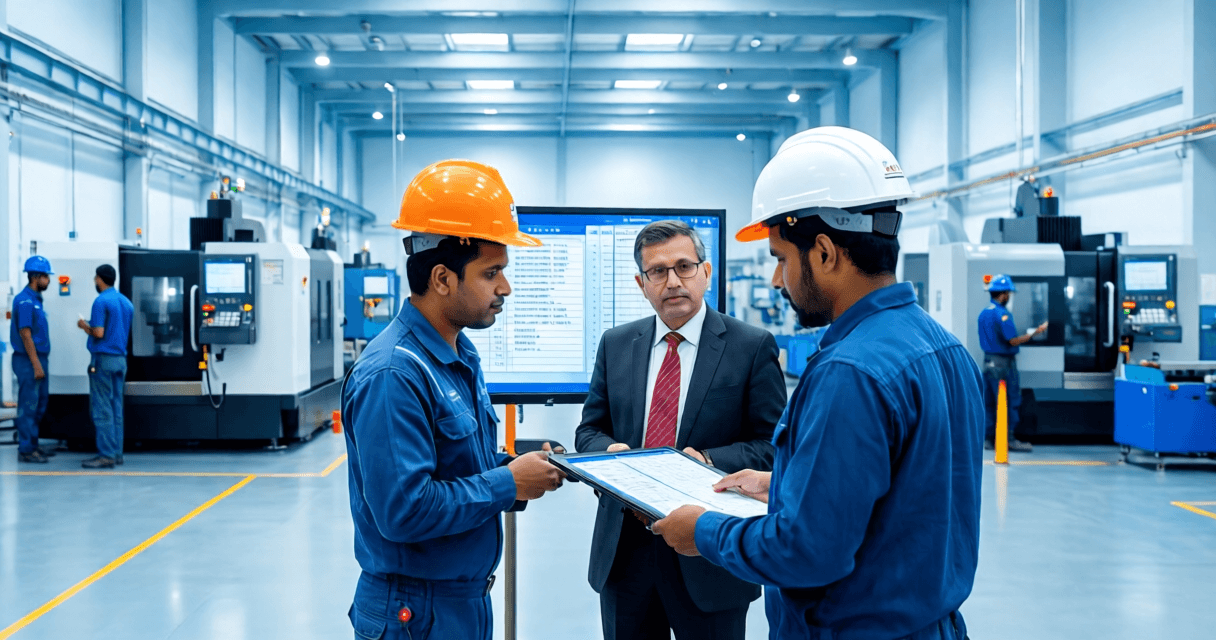
A single hour of unplanned downtime on a CNC line in Uppal Industrial Area costs between ₹50,000 and ₹5 lakh in lost throughput, overtime backlogs, and penalty clauses written into customer contracts. For a plant manager running a hydraulic press in Balanagar or a packaging cell in Jeedimetla, that figure is not a line item in a risk register. It is the number that hits the P&L before the technician has picked up a wrench. Across Hyderabad's 14 active industrial clusters — where 22-hour shifts keep textile, metal-forming, and packaging operations running around the clock — the decision between on-demand machinery repair vs contract service now shapes the production calendar, the ISO audit trail, and the bottom line for every MSME unit in the city.
Understanding the Failure
A breakdown at 2:40 a.m. on a Tuesday in the Kattedan Industrial Area does not wait for your preferred vendor's Monday shift to begin. A 315-tonne hydraulic press in a metal-forming unit seizes its ram cylinder, the accumulator loses pressure, and the entire stamping line stops dead. The shift supervisor dials the number on the vendor's letterhead, holds for eleven minutes, and is told the technician will arrive "tomorrow morning, God willing." By 7 a.m., the plant has lost roughly 4.5 hours of production. At a throughput of 12,000 stamped components per hour, that is 54,000 units missing from the delivery truck already loaded at the logistics bay.
This is the exact scenario that separates on-demand machinery repair vs contract thinking. Under a traditional annual service contract, your factory is locked into one vendor, one response SLA, and one escalation chain. If that vendor is overloaded, understaffed, or simply slow to dispatch, your line sits idle and you cannot redirect the problem. The contract says "within 24 hours," but 24 hours of downtime on a packaging machine in Jeedimetla Cluster is not a 24-hour service problem. It is a 24-hour revenue problem.
On-demand repair inverts that logic. You describe the failure, the machine make, the error code, and your location. A dispatch algorithm scans a pool of certified technicians in your radius and presents multiple bids, ETAs, and verified skill profiles before you commit to a single person. No single point of failure in the response chain.
Hyderabad's manufacturing base makes this distinction acute. The city hosts over 400 MSME units across the Uppal, Secunderabad, and Patancheru IDA zones, most running between one and eight machines per cell. A voltage fluctuation from the local feeder during the monsoon months of June through September can trip a VFD on a compressor, corrode a PLC board in a textile winding frame, or blow a solenoid valve in a pneumatic press. These are not rare events. They are seasonal certainties. A factory locked into a single contract vendor is one phone call away from a three-day wait. A factory that can dispatch a verified expert within 90 minutes is one call away from a 45-minute repair.
The MachineryFix platform routes factories to identity-verified technicians through its Intelligent Dispatch Engine, with live tracking from dispatch to factory gate. The plant manager in Balanagar does not sit in a waiting room. They watch a map. They see the technician's name, their verified skill evaluation score, and the ETA updating in real time. The operational difference between "we will try to send someone" and "Ravi Kumar, hydraulic systems specialist, 42 minutes away, identity verified at the gate" is the difference between a managed incident and an unmanaged crisis.
Immediate Response Steps
The first 30 minutes after a breakdown determine whether your recovery takes two hours or two days. Maintenance supervisors in the Nacharam IDA zone and the Cherlapally electronics corridor have learned this the hard way: a compressor that overheats at 10 a.m. and sits unattended until 6 p.m. will have seized its bearings by the time anyone opens the casing. Thermal damage compounds. The repair cost triples. The downtime stretches from a 90-minute service call to a full-day parts replacement.
The first 30 minutes should follow a fixed sequence, regardless of whether you operate under an on-demand or a contract model:
- Isolate the machine. Cut the main power, lock out the tag, and prevent a secondary operator from restarting a failing drive.
- Document the failure. Photograph the error code on the HMI panel, note the last production count, and record the ambient temperature and humidity in the bay. Dust ingress from the open-sided factory sheds common in Hyderabad's industrial estates is a silent accelerator of bearing wear.
- Identify the machine make, model, and serial number. A CNC turning centre from a 2016 batch and one from a 2023 batch may share a spindle housing but use entirely different bearing seals.
- Dispatch the technician. Under a contract model, you call your vendor and hope. Under an on-demand model, you open the app, describe the symptoms, and the dispatch engine presents two or three nearby certified technicians with their ETAs and competitive bids.
The competitive bidding mechanism is where the on-demand model earns its keep. A plant manager at a packaging unit in Jeedimetla Cluster recently saved 20 percent on a conveyor belt repair because the platform showed her three verified technicians, their proposed parts, and their labour rates side by side. She accepted the bid that matched her urgency window. Under a fixed contract, she would have been stuck with the vendor's standard rate card, no questions asked.
MachineryFix's 24/7 emergency support line operates around the clock. If your hydraulic press fails at 3 a.m. on a Saturday in the Sanathnagar SEZ, you do not wait for Monday. You call or WhatsApp +91 70133 33007, describe the failure, and the Intelligent Dispatch Engine routes the nearest available expert. The technician arrives with a digital job card already generated, the machine's history pulled from the Digital Service Catalogues, and OEM-grade spares in the van. The factory gate sees a verified identity, not a stranger with a toolbox.
The wrench is the same in both models. What changes is the 90-minute window between "the machine is dead" and "a qualified expert is at your bay door." In Hyderabad's manufacturing economy, that window is the entire game.
Common Root Causes
The same four failure patterns repeat in MSME factories across Bollaram, Uppal, and Secunderabad, year after year, season after season. Recognising them is not an academic exercise. It is the difference between a ₹18,000 bearing replacement and a ₹2.4 lakh spindle rebuild.
Voltage instability and power quality. Hyderabad's industrial feeders, particularly in the older IDA phases of Secunderabad and Patancheru, experience voltage dips of 12 to 18 percent during peak summer months when ambient temperatures cross 42 degrees Celsius. A VFD on a CNC lathe that is not properly rated for these swings will log fault codes, degrade its IGBT modules, and eventually fail catastrophically. A compressor's motor winding insulation breaks down not in one event but over 40 to 60 cycles of overvoltage surges from the utility's switching operations.
Monsoon humidity and dust ingress. From June through September, relative humidity in open-sided factory bays regularly exceeds 85 percent. Condensation forms on PLC boards, corrodes relay contacts, and degrades the dielectric in hydraulic accumulators. Simultaneously, the dust load from unpaved access roads in clusters like Kattedan and Nacharam works into every open bearing, every linear guide, every air-cooled motor. A textile service unit in the VNR Textiles corridor reported that 60 percent of their unplanned spindle failures traced back to dust contamination of the way covers — a problem no scheduled annual contract visit catches, because the visit is calendar-driven, not failure-triggered.
Skilled technician shortage. India's industrial workforce is ageing. The generation of ITI-certified fitters who could read a hydraulic schematic, diagnose a servo drive fault, and replace a timing belt without a manual is retiring. The replacement generation has smartphone fluency but limited bench experience. This is why a vetted-technician model matters. A technician who has passed a rigorous skill evaluation on hydraulic systems, CNC kinematics, and pneumatic circuits is not the same as a general electrician with a multimeter and a guess.
Deferred maintenance and undocumented history. Most MSME factories in Telangana do not maintain a structured repair log. The last time the hydraulic press was serviced, who serviced it, what parts were replaced, and what the diagnostic reading was all live in a maintenance supervisor's memory or a crumpled paper logbook. When the machine fails again in eight months, there is no baseline. The technician is guessing. The parts ordered are wrong. The second visit costs more than the first repair.
MachineryFix's Digital Service Catalogues close this gap. Every repair, every part number, every diagnostic reading, and every technician's notes are stored digitally and attached to the machine's record. When the same hydraulic press fails in the Cherlapally zone eight months later, the incoming technician sees the full history before they open the casing. The repair is targeted, not exploratory. Venkat Reddy, operations lead at VNR Textiles, confirmed that matching the right hydraulic expert with full service history in hand cut their turnaround time significantly.
Preventive Actions
Reactive repair is the most expensive form of maintenance, and it is also the most common in Indian MSME plants. A factory that runs three shifts, 300 days a year, with a maintenance budget that covers consumables and a single annual shutdown will always be tempted to "fix it when it breaks." The arithmetic, however, is unforgiving. A ₹20,000 preventive bearing replacement in April saves a ₹1.8 lakh emergency spindle overhaul in August, when monsoon humidity has already corroded the raceways.
The preventive actions that actually move the needle in a Hyderabad manufacturing plant are specific and measurable:
- Schedule vibration analysis on all rotating equipment — spindles, compressor rotors, pump shafts — at 90-day intervals. A 0.8 mm/s RMS reading on a CNC spindle is normal. A 3.2 mm/s reading is a bearing about to spall. You catch it in the data, not in the production loss.
- Inspect and replace air filters and way covers on CNC machines every 60 days during monsoon months. The parts cost under ₹5,000. The cost of a dust-laden linear guide is ₹80,000 to ₹2 lakh in resurfacing.
- Perform a full hydraulic fluid analysis — viscosity, particle count, water content — every 200 operating hours on presses and hydraulic power units. Contaminated fluid is the number one cause of cylinder seal failure in Telangana's manufacturing sector.
- Maintain a digital service log for every machine, every repair, every part. This is not a bureaucratic exercise. It is the backbone of ISO 9001 and ISO 14001 compliance audits.
The Predictive Maintenance AMC module in the MachineryFix ecosystem reframes this conversation. Rather than a blanket annual contract that sends a technician to "check everything" once or twice a year, the AMC is structured around your machine fleet's actual failure modes. The technician visits at calibrated intervals, runs diagnostics, updates the Digital Service Catalogues, and flags components trending toward failure. The factory manager receives a specific report: "Bearing on spindle axis 2 is at 72 percent of its rated life. Recommend replacement within 120 operating hours."
Anita Desai, compliance lead in Cherlapally, noted that the digital service logs maintained through the platform made their ISO audit preparation significantly easier. Every repair was timestamped, attributed to a verified technician, and linked to a specific machine serial number. No more reconstructing six months of maintenance history from photocopies and memory. The audit trail was clean, searchable, and defensible.
Indian factory owners can book a certified technician directly from their phone, with upfront pricing before any work begins. The booking flow is identical whether you need a one-off emergency repair or a structured AMC visit. You describe the machine, the symptoms, and your location. The platform handles the rest.
How MachineryFix Helps
The gap between "the machine broke" and "the machine is running again" is where most of your money is lost. Not in the parts. Not in the labour. In the waiting. In the phone calls. In the "my guy is coming tomorrow" that turns into "my guy's guy is coming Thursday."
MachineryFix closes that gap through a deliberately short process:
- Step 1: Describe the problem. Open the app or call the line. State the machine make and model, the symptoms, the error code if visible, and your industrial zone. Two minutes of input.
- Step 2: Get matched instantly. The Intelligent Dispatch Engine scans the Vetted Technician Network for certified specialists in your radius. You see two or three technicians, their skill ratings, their ETAs, and their competitive bids. You compare. You choose.
- Step 3: Technician arrives. Live status tracking from dispatch to your factory gate. The technician's identity is verified at the gate. The digital job card is already generated with your machine's service history pulled from the Digital Service Catalogues.
- Step 4: Back up and running. OEM-grade parts from the technician's van or dispatched from a local depot. The repair is documented. You approve the job card. You pay. The record is stored.
The mutual rating system keeps the relationship two-directional. You rate the technician. The technician rates your factory's access, documentation, and payment discipline. This feedback loop holds the quality of the network high. The 4.8/5 average rating across the platform reflects thousands of factory-to-technician interactions spanning 14 industrial categories — CNC machines, lathes, hydraulic presses, compressors, welding equipment, conveyor systems, packaging machines, and textile machines.
Privacy is handled at the protocol level. All communication between the factory and the technician stays inside the platform. No personal phone numbers are exchanged. No WhatsApp groups. No forwarded call records. For a plant manager in the Secunderabad MIDC zone who has had a contractor leak a machine specification to a competitor, this is not a nice-to-have. It is a requirement.
The re-hiring feature adds a layer of operational control. If the hydraulic specialist who fixed your 315-tonne press in Balanagar Industrial Zone did a clean job, you save his profile. Next quarter, when the same press needs a seal kit replacement, you skip the bidding. You call your person. You know his rate. You know his skill. You know his ETA. That is the best of both models: the speed and transparency of on-demand repair with the continuity and trust of a contract relationship.
Why MachineryFix Is India's Fastest Repair Network
Speed is not a single metric. It is a system. It is the 90 seconds it takes to describe a failure in the app. It is the 12 seconds it takes the Intelligent Dispatch Engine to match you with the nearest verified technician. It is the 38 minutes it takes that technician to drive from the Patancheru IDA zone to your bay in Kattedan. It is the 45 minutes it takes to replace a hydraulic cylinder seal, pull a bearing from the local depot, and have the machine back under load before your next shift starts. Multiply that by the ₹50,000 to ₹5 lakh you lose every hour the line sits dead, and the case for a faster response chain stops being a preference. It becomes a survival calculation.
Suresh Nair, who runs a press line in Balanagar Industrial Zone, put it plainly: "Press line turnaround improved dramatically with MachineryFix." Rakesh Sharma in Kattedan Industrial Area reported that his downtime dropped significantly after switching from a single-vendor contract to the on-demand model. Priya Kumari in Jeedimetla Cluster saved 20 percent on her last repair simply because she could compare three bids before accepting one. These are not testimonials. They are the operating data of factories that stopped accepting "tomorrow morning, God willing" as a service level.
The choice in front of every MSME plant manager in Hyderabad — and in the 200-plus industrial clusters across Telangana, Maharashtra, Tamil Nadu, and Gujarat that MachineryFix now covers — is not between a good technician and a bad one. It is between a system that responds in 90 minutes and one that responds in 90 hours. Between a repair you can audit, trace, and rehire, and one that lives in a crumpled logbook in a supervisor's drawer. Between a platform that shows you the technician's name, skill score, and ETA before he reaches your gate, and a phone call that ends with "someone will come, I think."
Your machine is not going to wait for your vendor's Monday shift.
Book a verified technician now — call or WhatsApp +91 70133 33007, describe the failure, and get matched with a certified expert in your zone within minutes. The next breakdown is already on the calendar. The only variable you control is how fast it gets fixed.
Published on
India's on-demand industrial repair platform — certified technicians dispatched fast.
Frequently Asked Questions
How do I get a technician for on-demand machinery repair vs contr in Hyderabad?
MachineryFix's Intelligent Dispatch Engine matches your breakdown with the nearest verified technician in Hyderabad. Available 24/7 for emergency support. Book at machineryfix.com or WhatsApp +91 70133 33007.
Are MachineryFix technicians verified and experienced?
Yes. Every technician on MachineryFix is an experienced engineer or technician, passing rigorous skill evaluation before being onboarded. This is why MachineryFix maintains a 4.8/5 average rating from factory clients across India.
What is a Predictive Maintenance AMC and how does it work?
A Predictive Maintenance AMC (Annual Maintenance Contract) from MachineryFix covers scheduled inspections, condition monitoring, and priority emergency response. It reduces unplanned breakdowns by 40-60% and is ideal for factories running critical CNC, hydraulic, or textile machines.
How much does industrial machine repair cost in India?
Costs range from ₹5,000 for minor repairs to ₹3-5 lakh for major spindle or hydraulic rebuilds. MachineryFix uses competitive bidding — you receive upfront proposals from multiple local experts before committing, so you always get a fair price.
What documentation does MachineryFix provide after a repair?
MachineryFix generates a Digital Service Catalogue entry for every job — logging the fault, diagnosis, parts replaced, technician ID, and timestamps. This digital job card is accepted for ISO 9001 and GMP compliance audits.
Can I rehire the same technician for future jobs or an AMC?
Yes. MachineryFix's re-hiring feature lets you save a preferred technician directly to your account. You can rebook them for follow-up work, recurring maintenance, or a full AMC contract — keeping your factory history consistent.
Need a certified technician?
Get one dispatched fast.