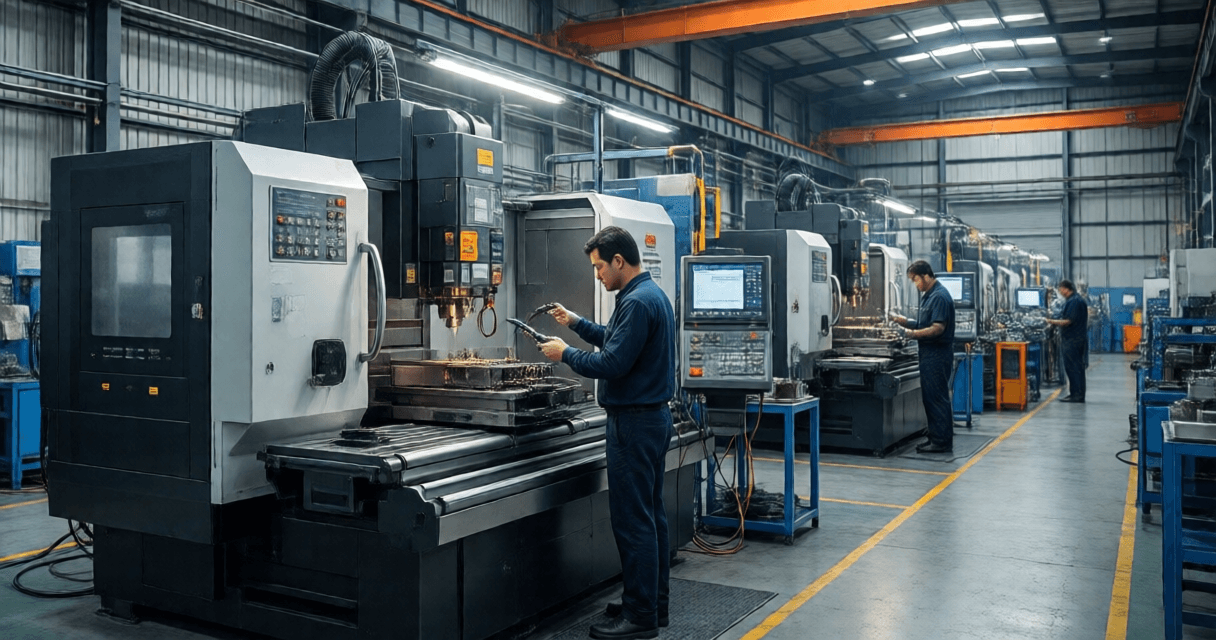
CNC Turning Center Fanuc Alarm Code Repair: Kattedan
Factory downtime costs lakhs per hour. Learn how CNC turning center Fanuc alarm code gets resolved fast. MachineryFix connects you with experienced technicians via Intelligent Dispatch.

MachineryFix Team
Industrial Repair & Maintenance Experts · 23 October 2026
Need this fixed?
Experienced technicians, from our Hyderabad hub.
# CNC Turning Center Fanuc Alarm Code Repair: Kattedan
A single Fanuc alarm code on a CNC turning center HMI screen costs a 24-hour-shift shop between ₹50,000 and ₹5 lakh per hour of unresolved downtime. For a Kattedan workshop running 200 shafts a day for a defense-sector subcontractor, a servo fault that sits for six hours erases a full week's margin before the shift supervisor files the incident report. The spindle is still turning. The turret is still indexed. The line is simply dead, and the delivery window is already slipping.
Walk the Kattedan Industrial Area on any Tuesday afternoon. You will find two or three CNC cells with amber or red alarm banners frozen on the operator screen, a plant manager refreshing a WhatsApp group, and a phone call to some technician in Uppal or Balanagar that comes back with "tomorrow, maybe." The average wait for an unstructured repair call in Hyderabad's manufacturing belt runs 36 to 72 hours. By the time the technician arrives, the spindle bearings have started to chatter, the linear way is scoring, and what was a 45-minute servo recalibration has become a 14-hour mechanical teardown with a ₹1.5 lakh parts bill.
The MachineryFix platform exists to collapse that 72-hour gap into a 90-minute response window. No phone tag.
Understanding the Failure
A Fanuc 0i, 16i, or 30i control does not throw an alarm in isolation. The code on your HMI screen is the last link in a chain that started 40 to 120 hours earlier. Alarm 414 (Servo Overload), Alarm 460 (Axis Overtravel), Alarm 200 (Spindle Overheating), and Alarm 300 (Encoder Signal Loss) account for roughly 70 percent of CNC turning center breakdowns across Hyderabad's metalworking clusters — Kattedan, Jeedimetla, Sanathnagar, and the Uppal belt.
What makes Fanuc alarms punishing for MSME shops in this corridor is the cascade. A single servo amplifier fault on the X-axis triggers secondary alarms on the Z-axis and the turret, locking the entire cycle. The operator, trained on G-code but not on Fanuc's internal diagnostic tree, sees three or four red codes and stops. The machine sits. The queue of 150 shafts meant for a DRDO subcontractor starts to slip.
Indian operating conditions accelerate the failure. Voltage swings of 10 to 15 percent are routine in Kattedan and Jeedimetla during peak summer load, when the 3-phase supply sags under the combined draw of every compressor and hydraulic press in the MIDC block. A single brownout desyncs a Fanuc encoder feedback loop without tripping an alarm immediately, but within two to three shifts the accumulated drift surfaces as Alarm 460 or a position-error spike. Monsoon humidity, particularly in the open-sided factory sheds common in Nacharam IDA and Patancheru, corrodes connector pins on the servo amplifier board within 60 to 90 days. Dust ingress from unsealed linear ways abrades encoder scales. The alarm code is a diagnosis, not a failure description. Two machines showing the identical Alarm 414 can have completely different root causes. One needs a 30-minute parameter reset. The other needs a full spindle bearing replacement. The difference between those two outcomes is the technician who reads the code, checks the servo gain parameters, inspects the mechanical coupling, and cross-references the machine's service history. A structured, verified repair network changes the economics of that decision.
Immediate Response Steps
The first 15 minutes after a Fanuc alarm locks your turning center determine whether the repair takes an hour or a day. The sequence below is what experienced maintenance engineers in Hyderabad's manufacturing belt actually follow. Most operators skip steps three and four, and that is where the cost multiplies.
Step one: Do not power-cycle the control. The instinctive response in Indian workshops is to kill the main power, wait 30 seconds, and restart. On a Fanuc 30i controlling a 12-station turret, that sequence scrambles the turret index memory and converts a software alarm into a mechanical misalignment requiring a full turret re-indexing. Press RESET on the operator panel instead. Note the exact alarm code and sub-code. Check the alarm history buffer (ALARM, then HISTORY). The sequence of alarms tells you which axis failed first.
Step two: Isolate the axis. If the alarm references a specific axis, jog it at 10 percent feed rate in both directions. Listen for grinding. Feel for binding. Watch the position readout for sudden jumps. A 2-micron jump while jogging at 0.1 mm/min is a classic encoder scale defect, common in machines running in dusty Kattedan sheds without proper air filtration on the linear ways.
Step three: Check the servo amplifier status LEDs. A blinking green LED on the Fanuc amplifier means the drive is in a fault state. A solid red LED means overcurrent. The distinction matters. Overcurrent points to a mechanical seizure. A fault state with no overcurrent points to a signal or parameter issue. Photograph the LED pattern with your phone. That image becomes part of the diagnostic record when the technician arrives.
Step four: Engage professional help before the shift ends. This is the step most MSME factories skip, and it is the single most expensive mistake in the sequence. Rakesh Sharma, who runs a machining unit in Kattedan Industrial Area, told us his downtime dropped significantly after he stopped waiting for "some guy from the market" and started calling a experienced technician within the first hour of the alarm. You enter the alarm code, the machine make, and your location.
Step five: Do not clear the alarm by overriding parameters unless you hold the machine's original parameter backup. Fanuc parameter files are machine-specific. A "fix" parameter pulled from a forum thread or a YouTube video can corrupt the backlash compensation values and turn a working axis into a loose, scoring one. A ₹45,000 repair becomes a ₹2.5 lakh spindle rebuild.
Common Root Causes
After servicing CNC turning centers across Kattedan, Uppal, Balanagar, and Cherlapally, a consistent pattern emerges in the root causes behind Fanuc alarm codes. The alarm is the tip. The cause is almost always one of five categories.
- Servo amplifier degradation from thermal cycling. Indian factory environments see ambient temperatures swing from 22 degrees in winter to 42 degrees in summer, often without adequate HVAC in the electrical panel enclosure. The electrolytic capacitors in Fanuc servo amplifiers lose capacitance after 3 to 5 years of that thermal stress. The result is intermittent overcurrent trips (Alarm 414) that worsen with each heat cycle. A replacement amplifier board costs ₹45,000 to ₹85,000. The real cost is the 4 to 8 hours of lost production while you source the part and wait for a technician who knows how to re-match the gain parameters.
- Encoder and feedback system failure. Linear encoder scales on the X and Z axes are precision glass strips. Dust, coolant mist, and the fine metallic particles generated by turning operations slowly abrade the reading surface. In Hyderabad's industrial zones, where many shops run without enclosed coolant systems, encoder failure is the number one mechanical cause of position alarms. The fix is a scale replacement and recalibration. In skilled hands, it takes 3 to 5 hours. In unskilled hands, 12 to 18.
- Spindle bearing wear and thermal drift. A turning center spindle running at 6,000 to 12,000 RPM generates significant heat. Inadequate cooling, often because the spindle oil pump has been "fixed" with a temporary bypass, causes bearing preload to shift. The Fanuc control interprets the changing torque demand as a servo overload and throws Alarm 414 or 415. By the time the bearing is actually failing, the repair runs 2 to 3 days with a ₹1.2 to ₹2.5 lakh parts bill.
- Parameter corruption or loss. Power outages remain a reality in many Telangana industrial zones despite improved grid reliability. A Fanuc parameter file corrupts if the machine loses power during a write cycle. The control boots, but the backlash compensation, servo gain, and axis travel limits are wrong. The operator sees cascading alarms that make no sense. Without a parameter backup, the machine is a ₹25 to ₹40 lakh paperweight until a technician reconstructs the parameters from the machine's documentation.
- Turret and sub-spindle mechanical faults. On turning centers with live tooling, the turret indexing motor and the sub-spindle coupling are high-wear items. A worn turret clutch dog produces a misalignment that the Fanuc control detects as a position error on the turret axis. The alarm code references the turret. The fix is mechanical: a clutch plate replacement and re-indexing.
Each of these causes demands a different set of tools, parts, and diagnostic depth. A generic "CNC repair" technician from a local market may handle the parameter reset but will fumble the encoder replacement or misdiagnose the spindle bearing issue. That mismatch is exactly what a vetted, skill-evaluated technician network is built to eliminate.
Preventive Actions
The most expensive Fanuc alarm code is the one that could have been prevented. For MSME factories in Hyderabad running CNC turning centers, a structured preventive maintenance routine is the single highest-return investment in the plant. Not a luxury. The arithmetic is straightforward.
- Monthly servo amplifier inspection. Open the electrical panel (main disconnect locked out) and visually inspect the servo amplifier boards for bulging capacitors, discoloured solder joints, and corroded connector pins. In the Telangana climate, the combination of humidity and dust creates a conductive film on the board surface within 60 to 90 days. A contact cleaner spray and a thermal paste refresh on the amplifier heatsink costs under ₹2,000. It prevents a ₹60,000 board failure and a full day of lost production.
- Quarterly encoder and linear way cleaning. Use a lint-free cloth and isopropyl alcohol to clean the linear encoder scales. Check the wiper blades on the scale housing for wear. Replace the wiper kit (₹3,500 to ₹5,000) every two quarters. This single action eliminates the most common cause of position-error alarms in dust-heavy environments like Kattedan and Jeedimetla, where open-sided sheds pull in particulate matter from the surrounding foundry and machining units.
- Spindle oil analysis every 200 hours. A ₹800 oil sample test reveals metallic particles before the bearing fails. If the iron particle count exceeds 500 PPM, schedule a bearing inspection before the next production run. That is the difference between a ₹45,000 bearing job and a ₹2.5 lakh spindle rebuild.
- Annual parameter backup and verification. Export the full Fanuc parameter file to a USB drive or the control's memory card. Store three copies: one on-site, one in the plant manager's office, one in the cloud. Verify the backlash compensation values against the machine's original documentation. This 30-minute task saves a multi-day parameter reconstruction after a power event, which is still a live risk in industrial blocks along the Uppal–Kattedan stretch where the 11 kV feed dips during peak summer demand.
- Predictive Maintenance AMC. The economics shift here. A Predictive Maintenance AMC contract with a structured schedule of monthly inspections, quarterly deep cleans, and annual spindle and servo health checks costs a fraction of a single emergency repair call. That audit trail is not a compliance checkbox. It is a living health record for the most expensive asset on the shop floor.
Related Services
- CNC controller repair in Hyderabad
- Industrial repair for CNC manufacturing
- Industrial repair in Kattedan, Hyderabad
Related Reading
- CNC VMC machine repair Hyderabad Uppal Kattedan industrial area
- CNC machine repair Hyderabad Uppal Kattedan industrial area
- Fanuc Alarm Codes: CNC Repair in Hyderabad
- Decoding Fanuc Alarms: CNC Turning Center Uptime in Hyderabad
- CNC Turning Center Uptime: Preventing Fanuc Alarms in Hyderabad
Why the Speed Difference Matters in a Hyderabad Shop Floor
Speed in industrial repair is not about the technician driving faster. It is about eliminating every non-productive step between the alarm and the fix. MachineryFix has engineered its process around that principle, and the numbers reflect it.
Priya Kumari, who manages a hydraulic press unit in the Jeedimetla cluster, saved 20 percent on a repair simply by comparing bids side by side. The Predictive Maintenance AMC shifts a factory from reactive firefighting to scheduled health checks, catching a failing servo capacitor in month four before it becomes a month-eight breakdown that shuts the line for three days.
Every job is tracked from the moment the alarm code is submitted to the moment the machine is back in production. Every communication stays inside the app, protecting the factory's operational data and the customer's specifications. Weekly technician payouts with full transparency keep the network motivated and the service quality consistent.
The average factory that moves to MachineryFix's on-demand repair and predictive maintenance combination sees unplanned downtime drop by more than 60 percent within the first two quarters. The alarm code still appears on the HMI screen. The difference is what happens in the next 90 seconds.
Your Fanuc alarm code is not a problem. It is a dispatch trigger. A experienced specialist in the Telangana corridor is matched to your job in under 90 seconds, with a confirmed ETA before the next part hits the chuck. Call or WhatsApp +91 70133 33007 if the line is down and you need a human on the phone. The machine is not going to fix itself.
Published on
Industrial machinery repair and maintenance, from our Hyderabad hub.
Frequently Asked Questions
How do I get a technician for CNC turning center Fanuc alarm code in Hyderabad?
Book at machineryfix.com or WhatsApp +91 70133 33007.
Are MachineryFix technicians verified and experienced?
Yes. Every technician on MachineryFix is an experienced engineer or technician, passing rigorous skill evaluation before being onboarded.
What is a Predictive Maintenance AMC and how does it work?
A Predictive Maintenance AMC (Annual Maintenance Contract) from MachineryFix covers scheduled inspections, condition monitoring, and priority emergency response. It reduces unplanned breakdowns by 40-60% and is ideal for factories running critical CNC, hydraulic, or textile machines.
How much does industrial machine repair cost in India?
Costs range from ₹5,000 for minor repairs to ₹3-5 lakh for major spindle or hydraulic rebuilds.
What documentation does MachineryFix provide after a repair?
This digital job card is accepted for ISO 9001 and GMP compliance audits.
Can I rehire the same technician for future jobs or an AMC?
Yes. MachineryFix's re-hiring feature lets you save a preferred technician directly to your account. You can rebook them for follow-up work, recurring maintenance, or a full AMC contract — keeping your factory history consistent.
Need a technician?
Send the fault code and we'll match one.