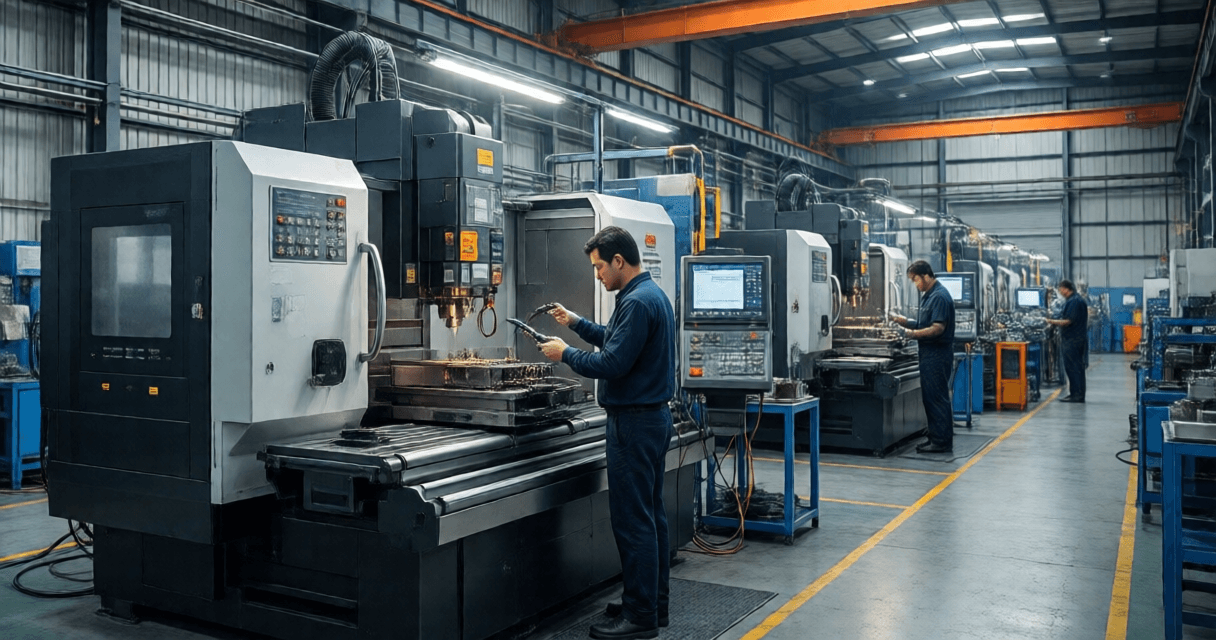
FFS form fill seal machine repair FMCG factory Hyderabad Uppal
Factory downtime costs lakhs per hour. Learn how FFS form fill seal machine repair F gets resolved fast. MachineryFix connects you with verified technicians via Intelligent Dispatch.

MachineryFix Team
Industrial Repair & Maintenance Experts · 25 October 2026
Need this fixed?
Experienced technicians, from our Hyderabad hub.
# FFS Form Fill Seal Machine Repair: FMCG Factory Hyderabad Uppal
An unplanned FFS form fill seal machine repair F event in a Hyderabad FMCG plant burns through ₹2 lakh to ₹5 lakh per hour — lost output, scrapped film, breached delivery SLAs, and a production calendar that is now a liability. In the Uppal and Kattedan industrial corridors, where packaging lines run 20 to 22 hours a day and distributors in Andhra Pradesh and Karnataka are waiting on a Tuesday dispatch, a single sealer failure or a misaligned form station shuts down an entire shift. The machine is not the problem. The 4 to 8 hours between "line is down" and "a technician who actually understands ultrasonic welding heads, heat-seal temperature controllers, and servo-drive calibration is standing at your gate" is where the real financial damage happens.
For plant managers operating in the Telangana FMCG and packaging cluster, that gap is the enemy. What follows is a field-level breakdown of what goes wrong with form-fill-seal units, what to do in the first 30 minutes, and how to build a repair response that protects your production calendar instead of apologising for it.
Understanding the Failure
A form-fill-seal machine is not one machine. It is three integrated subsystems — the form station (where the pouch is shaped from roll stock), the fill station (where product is metered and dispensed), and the seal station (where the top and bottom heat seals are applied) — all governed by a single PLC and a synchronized conveyor. When one subsystem drifts out of tolerance, the downstream units cascade into failure. A 0.3 mm misalignment at the form station produces an uneven pouch at the fill station, which then feeds a crooked pouch into the seal jaws. The result: rejected product, wasted film, and in the worst case, a jam that trips the entire line.
In the Uppal and Jeedimetla packaging clusters, the most common failure signature reported by maintenance heads is a heat-seal inconsistency — the top seal is weak, product leaks within 48 hours, and the batch is quarantined. The root cause is rarely the sealer bar itself. It is almost always a combination of degraded thermocouple feedback, worn PTFE tape on the seal plate, and the ambient humidity spike that Telangana's monsoon season brings to an unsealed factory floor.
A maintenance engineer at a Kattedan-based FMCG unit described the scenario: "We lost two full shifts because the seal bar temperature was reading 180 degrees but actually sitting at 155. Nobody caught it until QA pulled a sample at hour six." That is a ₹3.4 lakh loss for a single 8-hour window, and it happened because the diagnostic loop was not closed in time.
The distinction that matters for any plant manager: an FFS failure is rarely a single-component event. It is a systemic tolerance drift that accelerates over 40 to 80 hours of continuous operation. If your line runs two shifts a day, that drift window closes in under 48 hours. That timeline changes how you structure your response.
Immediate Response Steps
The first 30 minutes after an FFS line stops determine whether your recovery takes 2 hours or 10. Experienced maintenance heads in the Hyderabad corridor follow a specific sequence:
- Isolate and document before you touch anything. Photograph the error code on the HMI panel, note the exact station where the fault triggered, and log the last known-good batch number. This documentation becomes critical for both the repair technician and your ISO 9001 audit trail. A plant manager at Cherlapally pointed to their Digital Service Catalogues record — the full repair history, parts replaced, and diagnostic readings — as the first thing their ISO auditor asked for. Without it, the audit finding can cost more than the repair itself.
- Power down safely but do not reset the PLC blindly. Many technicians, when they arrive, immediately cycle the power. On an FFS unit, a blind reset masks the fault code and forces a full recalibration of the servo axes, adding 2 to 3 hours to the job. Let the diagnostic memory persist until the technician has read it.
- Clear the product and film from the form and fill stations. This is a safety step. Roll stock under tension and partially formed pouches in the seal jaws are pinch and burn hazards. Clear the line before any diagnostic work begins.
- Call for a verified technician with specific FFS experience, not a general electrician. This is where the response gap widens. A general industrial electrician in Sanathnagar or Patancheru can fix a contactor or a VFD. They cannot recalibrate a dual-axis ultrasonic welder or troubleshoot a servo-coupling backlash issue on the form drum. You need someone who has serviced that specific machine family before.
- If the failure is after 8 PM or on a weekend, use 24/7 emergency support. The Hyderabad FMCG cluster runs on tight delivery windows to distributors in Andhra Pradesh, Karnataka, and Maharashtra. A Sunday-morning failure that is not resolved by Tuesday morning means a missed dispatch and a penalty clause in your customer contract. A plant manager at Balanagar Industrial Zone reported that their press-line turnaround improved dramatically after they stopped relying on a single local electrician and started using a platform that could dispatch a verified specialist within 90 minutes, even at 2 AM.
Common Root Causes
Across the Telangana packaging belt, five root causes account for roughly 80 percent of all form-fill-seal breakdowns. The pattern is consistent from Nacharam IDA to Bollaram:
- Heat-seal thermal drift. The PTFE tape on the seal bar degrades with every pass. In a factory that runs 20 hours a day, the tape can lose 10 to 15 percent of its thermal conductivity within 3 weeks. The thermocouple still reads the target temperature, but the actual seal surface is running 15 to 25 degrees cooler. The seal sets, looks fine in a visual check, and fails in the customer's warehouse. This is the single most common and most expensive failure mode in the Uppal and Nacharam IDA zones.
- Servo-drive backlash on the form drum. The form station uses a pair of servo motors to rotate the forming tube. Over time, the coupling wears, and 0.5 to 1.2 degrees of backlash develops. The pouch forms with a slight twist. At the fill station, the nozzle misses the center. At the seal station, the jaws close on a misaligned pouch. The line jams. The fix is a coupling replacement and a full servo recalibration — a job that takes a trained FFS technician 3 to 4 hours, not a general electrician's "I will just tighten the bolts" approach.
- Voltage fluctuation and power quality. Telangana's industrial power supply, while improved significantly under the state's infrastructure push, still sees voltage sags of 12 to 18 percent during peak summer load. An FFS PLC and its servo drives are sensitive to this. A single 200 ms voltage dip can trigger a servo fault, and the machine stops. In the Bollaram and Sanathnagar corridors, where the distribution feeder is shared with residential load, this happens more frequently. A surge protector or an online UPS on the PLC cabinet is not optional; it is a production-critical component.
- Contamination and dust ingress. FMCG factories handle powders, granules, liquids, and semi-solids. Over months, fine particulate accumulates in the form station's guide rails, the fill nozzle's metering mechanism, and the seal jaw's alignment pins. The machine runs, but tolerances creep. The fix is a full disassembly and cleaning cycle that a technician should schedule every 90 days, not after the machine has already broken.
- Operator handling and film changeover errors. When a film gauge or substrate changes, the operator adjusts the form tube diameter, the seal pressure, and the fill volume. A 2 mm error in the forming tube setting will not show up until the third hundred pouches. In a high-volume plant producing 40,000 units per hour, that is 20 minutes of substandard product before QA catches it.
Preventive Actions
A preventive intervention on an FFS line costs a fraction of a reactive repair. High-performing FMCG plants in the Hyderabad corridor have already made this shift:
- Run a 90-day seal-bar replacement cycle. Do not wait for the PTFE tape to visibly degrade. Replace it on a fixed schedule. Log the replacement in your maintenance record. A maintenance head at a Jeedimetla packaging unit reported that after moving to a fixed 90-day cycle, their seal-failure complaints from customers dropped to zero over two consecutive quarters.
- Perform a monthly servo-backlash check. Using the machine's diagnostic mode, measure the form-drum coupling backlash. If it exceeds 0.3 degrees, schedule a coupling inspection within 72 hours. This is a 15-minute check that prevents a 4-hour emergency repair.
- Install a power-quality monitor on the FFS line's dedicated feeder. A ₹15,000 to ₹25,000 online power meter logs every voltage sag, harmonic spike, and frequency deviation. When the machine trips, you know in 30 seconds whether it was a power event or a mechanical fault, and you have the data to file a complaint with TSSPDCL or to justify an UPS upgrade to your CFO.
- Train your operators on changeover SOPs. A 2-hour training session on the correct sequence for film gauge changes, seal pressure verification, and fill-volume calibration prevents the majority of operator-induced tolerance drift. Document the SOP at the machine HMI station, not in a binder in the office.
- Adopt a structured predictive maintenance contract. Instead of calling a technician only after the machine breaks, a Predictive Maintenance AMC brings a certified FFS specialist to your plant on a fixed schedule — monthly or quarterly — to inspect the seal bar, check servo couplings, clean the form station, verify the fill meter, and update the PLC firmware. The technician carries the parts. The inspection is logged digitally. The cost is a fraction of a single emergency repair call.
- Maintain a digital service log for every intervention. Every repair, every part replaced, every diagnostic reading. This log is your ISO 9001 evidence, your customer audit defense, and your internal troubleshooting reference. A plant manager at Cherlapally specifically highlighted that the Digital Service Catalogues feature made their last ISO audit "frankly the easiest one we have done in four years."
How the Platform Works for an FFS Breakdown
When your FFS line is down at 11 PM on a Friday and your regular electrician is not answering his phone, the question is not "who can I call?" It is "who can I trust to be at my gate in under 2 hours with the right tools and the right experience?"
The MachineryFix platform handles this moment with a specific sequence. You open the app, describe the failure — "FFS line stopped, top seal weak, error code E-217 on HMI, machine make and model, 40,000 units per hour line" — and the Intelligent Dispatch Engine matches your breakdown with the nearest certified FFS technician who has a verified repair history on that specific machine family. The technician comes from the Vetted Technician Network, a pool of engineers who passed a documented skill evaluation on FFS diagnostics before onboarding. You see their profile, their past jobs, their rating, and their ETA.
Two or three qualified technicians can submit competitive bidding proposals — diagnosis, parts, labour, timeline — and you compare them side by side before accepting. A plant manager in the Jeedimetla cluster reported that competitive bidding saved them 20 percent on their last hydraulic press repair. The same transparency applies to FFS work.
The technician arrives at your factory gate, and you verify their identity on the spot. All communication — photos of the fault, diagnostic readings, parts pricing, approval for the repair — stays inside the app. No phone calls to a middleman, no WhatsApp screenshots being forwarded to a supervisor, no ambiguity about what was approved and what was not.
The repair is completed with OEM-grade or equivalent parts. You receive a digital job card with the full diagnostic, the parts replaced, the before-and-after readings, and the warranty terms. You approve and pay in the app. The entire job is logged in the Digital Service Catalogues, building a permanent, audit-ready service history for that specific machine.
The platform maintains a 4.Indian factory owners can book a certified technician directly from their phone, with upfront pricing before any work begins.
Why the Dispatch Model Matters for Indian MSME Factories
India's MSME manufacturing base — 63 million micro, small, and medium enterprises employing over 110 million workers — does not have the luxury of a 48-hour repair turnaround. A form-fill-seal line that is down for two days does not just lose two days of production. It loses the customer's trust, the distributor's slot, and the plant manager's credibility with the factory owner.
The structural gap is real: most MSME plants in tier-2 and tier-3 industrial corridors still rely on a single local electrician's phone number, a WhatsApp group of "guys who fix machines," or a call centre that takes 3 days to dispatch a generalist. The repair response model described above addresses that gap with specific mechanics:
- Proximity-based dispatch matched to skill, not just distance. The Intelligent Dispatch Engine does not send the nearest technician. It sends the nearest *qualified* technician. For an FFS line in the Kattedan Industrial Area, that means a specialist who has serviced 40 or more FFS units in the last 12 months, not a generalist who "knows a little about packaging machines."
- Identity verification at the factory gate. Every technician who arrives at your plant has passed identity checks and a documented skill evaluation before joining the Vetted Technician Network. You are not gambling with a stranger. You are receiving a certified professional whose credentials you can verify on the spot.
- Full digital service trail. Every repair, every part, every diagnostic reading is captured in the Digital Service Catalogues. When your ISO auditor walks the floor, you pull up the machine's complete history on a tablet. When a customer asks for a quality traceability report, you send the service log. When your CFO asks why the FFS line has been repaired four times this quarter, you show the data and the root-cause trend.
- 24/7 emergency coverage with a single WhatsApp message. A plant manager at Balanagar Industrial Zone put it plainly: "MachineryFix matched us with the right hydraulic expert in under an hour, on a Sunday evening, and the line was back by Monday 6 AM."
- Mutual rating and re-hiring. After every job, you rate the technician. The technician rates your plant's access, power supply, and communication clarity. If a technician consistently performs well on your FFS line, you rehire them directly for your Predictive Maintenance AMC or for the next repair. No re-searching. No re-explaining the machine.
Across the Uppal, Kattedan, Balanagar, Jeedimetla, and Cherlapally industrial corridors, factories that have moved from reactive, phone-book repair to a structured, platform-mediated repair process report measurable reductions in unplanned downtime, lower per-repair costs through competitive bidding, and cleaner compliance records for ISO and customer audits.
If your FFS line is running and you want to protect it, or if it is down right now and you need a verified technician at your gate in under 2 hours, the path is direct. [Book a Technician](https://machineryfix
Related Services
- Industrial breakdown repair in Hyderabad
- Industrial repair for packaging lines
- Industrial repair in Uppal, Hyderabad
Related Reading
Published on
Industrial machinery repair and maintenance, from our Hyderabad hub.
Frequently Asked Questions
How do I get a technician for FFS form fill seal machine repair F in Hyderabad?
MachineryFix's Intelligent Dispatch Engine matches your breakdown with the nearest verified technician in Hyderabad. Available 24/7 for emergency support. Book at machineryfix.com or WhatsApp +91 70133 33007.
Are MachineryFix technicians verified and experienced?
Yes. Every technician on MachineryFix is an experienced engineer or technician, passing rigorous skill evaluation before being onboarded. This is why MachineryFix maintains a 4.8/5 average rating from factory clients across India.
What is a Predictive Maintenance AMC and how does it work?
A Predictive Maintenance AMC (Annual Maintenance Contract) from MachineryFix covers scheduled inspections, condition monitoring, and priority emergency response. It reduces unplanned breakdowns by 40-60% and is ideal for factories running critical CNC, hydraulic, or textile machines.
How much does industrial machine repair cost in India?
Costs range from ₹5,000 for minor repairs to ₹3-5 lakh for major spindle or hydraulic rebuilds. MachineryFix uses competitive bidding — you receive upfront proposals from multiple local experts before committing, so you always get a fair price.
What documentation does MachineryFix provide after a repair?
MachineryFix generates a Digital Service Catalogue entry for every job — logging the fault, diagnosis, parts replaced, technician ID, and timestamps. This digital job card is accepted for ISO 9001 and GMP compliance audits.
Can I rehire the same technician for future jobs or an AMC?
Yes. MachineryFix's re-hiring feature lets you save a preferred technician directly to your account. You can rebook them for follow-up work, recurring maintenance, or a full AMC contract — keeping your factory history consistent.
Need a technician?
Send the fault code and we'll match one.