
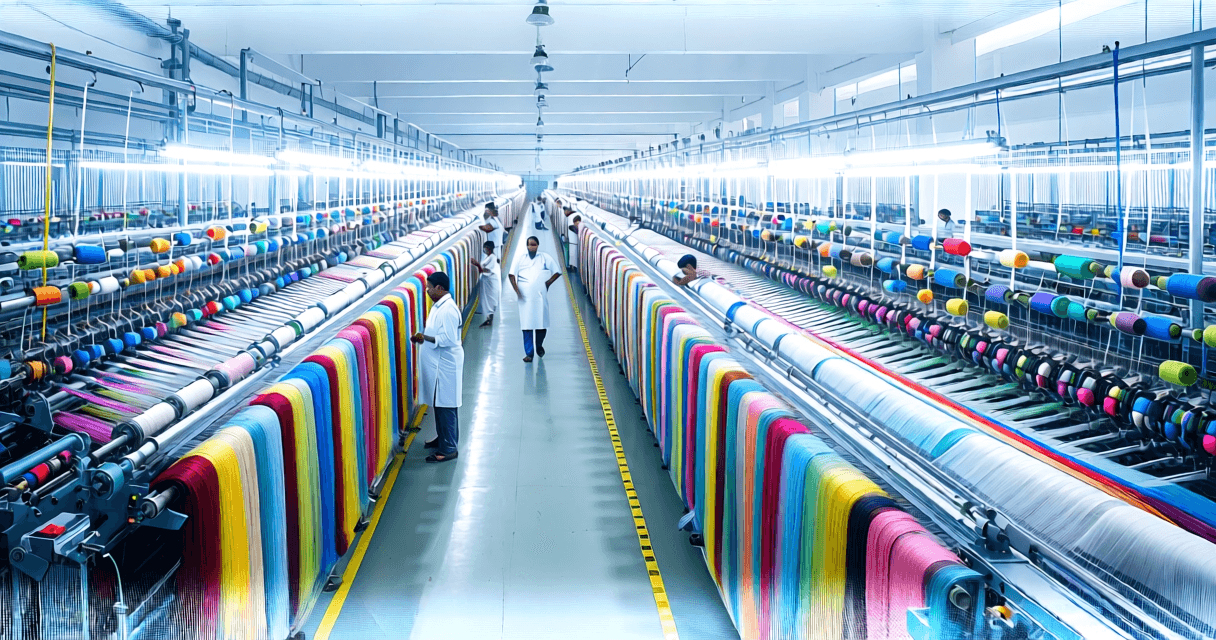
Airjet Loom Breakdown Repair: Tiruppur Textiles
Unscheduled loom breakdowns halt production and drain revenue. This article explains typical failure causes, what to inspect before calling, and the factors that shape repair costs. Call 24/7: +91 70133 33007.

MachineryFix
Industrial Repair & Maintenance Experts · 3 July 2026
Need this fixed?
Experienced technicians, from our Hyderabad hub.
Warning: Factory Downtime is Not Just an Inconvenience; It Is an Immediate Financial Crisis.
In Tamil Nadu’s competitive knitwear industry, where the clock dictates profitability, machine stoppage presents a staggering financial risk. For large-scale textile operations in clusters like Tiruppur or Coimbatore, loom failure can easily cost between ₹50,000 and over ₹5 lakh per hour—a figure dependent on shift timing, labor costs, and critical order commitments. This reality elevates reliable airjet loom repair services in Tamil Nadu beyond mere operational upkeep; it becomes a core component of financial risk management. Factory owners across these industrial hubs urgently seek technical solutions that bypass the slow, traditional service models toward guaranteed uptime.
The Economics of Downtime: Quantifying the Cost of Loom Stoppage in Modern Textile Mills
Plant Managers overseeing high-speed textile operations must look past simple wage bills to understand the true cost of downtime. When a core machine—be it an airjet or rapier loom—stops, regardless of whether the cause is a tripped motor, sensor malfunction, or complex feeding system failure, the cumulative loss impacts multiple departments simultaneously.
Hidden Costs Beyond Lost Production Units The economic impact of even a few hours of stoppage includes:
- Opportunity Cost: The inability to fulfill committed orders, leading directly to contractual penalties and damage to established supply chain relationships.
- Labor Idleness: Paying skilled operators who cannot work represents wasted man-hours that could otherwise be utilized for proactive maintenance or quality assurance checks.
- Energy Loss: Continued consumption of power by ancillary systems (HVAC, lighting) while the core production line stands stalled.
Consider a scenario in an industrial zone like Balanagar: voltage fluctuations can halt a press line. If local repair services take half a day merely to diagnose and procure parts, the lost revenue easily exceeds the cost of preventative maintenance. The modern factory must treat machine uptime as its single most valuable commodity. This realization is why leading manufacturers are increasingly adopting platforms that guarantee rapid response. For instance, MachineryFix's immediate access to specialized expertise helps reduce Mean Time To Repair (MTTR) from days to mere hours.
The Difference Between Reactive and Proactive Finance Reactive maintenance—fixing things *after* they break—is financially punitive because it forces payment of premium emergency rates for limited, often overstretched local resources. Conversely, adopting a proactive approach models itself on risk mitigation. This shift demands detailed data logging and immediate expert deployment. We must transition from merely counting lost hours to systematically reducing the probability of that loss occurring in the first place. The ability to compare proposals and select the most efficient repair partner before committing funds—a feature achieved through **competitive bidding**—ensures financial discipline even during a crisis.
Common Failures: Advanced Troubleshooting for Airjet and Rapier Looms (From Sensors to Feed Systems)
Advanced airjet looms represent complex electromechanical systems operating under extreme precision demands. A breakdown rarely stems from a single point of failure; rather, it is often a cascading issue involving multiple interconnected subsystems. To effectively manage airjet loom repair services in Tamil Nadu, engineers must master the diagnosis of key components beyond superficial fixes.
Focus Area 1: Electronic & Sensor Malfunctions Many modern looms operate using complex control units (PLCs) and dozens of sensors—proximity, tension, speed—as their governing systems. A sudden stoppage frequently triggers not from a physical jam, but from a sensor reporting an anomalous reading, whether it is a false positive or genuine failure. Troubleshooting demands specialized diagnostic tools and experts who understand the specific PLC logic tied to the loom's make and model. Determining if the issue involves wiring faults, signal degradation, or actual component failure saves critical hours of guesswork.
Focus Area 2: Feeding and Weaving System Failures The feeding systems (take-up rollers, shedding mechanisms) endure continuous stress from high speeds and humidity variations common across Indian textile clusters. Common issues include:
- Tension Consistency: Inconsistent yarn tension leading to breakage or machine slowdowns.
- Cam/Timing Issues: Wear on timing belts and cams due to relentless operation, requiring precise replacement parts.
- Dust Ingress: Dust accumulation (particularly in high humidity environments) causing overheating or misalignments within motor bearings.
Focus Area 3: Power and Electrical Integrity Voltage fluctuations remain a perennial concern across India’s industrial zones. Even if the loom appears to function, fluctuating power damages delicate circuitry over time. A thorough service check must analyze the entire electrical signature—from the main panel down to individual motor feeders—to prevent catastrophic failure before it happens. Using **Digital Service Catalogues** ensures that every repair history, including voltage logs and parts replacements, records instantly for compliance audits, making them perfect assets for ISO standards adherence.
> Factories can book verified, experienced technicians through machineryfix.in, with a digital job card kept for every repair.
Why Traditional Repair Fails: The Gap Between Local Expertise and 24/7 Digital Response
Historically, when a loom broke down in an industrial zone like Uppal or Ambattur, the response relied almost entirely on physical proximity and personal networks. This model is inherently unstable for large-scale, modern manufacturing operations.
The Problem of Fragmentation Traditional service providers often operate in silos: one electrician handles wiring, another manages mechanical parts, and a third addresses PLC programming. Coordinating multiple specialists simultaneously—especially at 2 AM during an emergency stoppage—is virtually impossible. This fragmentation causes significant delays, unpredictable pricing structures, and compromises on quality control standards.
The Myth of 'Local Expertise' While local knowledge holds value, it does not equate to standardized, accountable service delivery. Without a centralized verification process, factory managers risk accepting repairs from uncertified personnel. Imagine calling for help via WhatsApp only to find the technician’s credentials or specialization questionable. The lack of accountability and verifiable skill sets constitutes the greatest weakness in the fragmented local repair market.
The Need for Digital Standardization What a modern facility requires is not just *an* expert, but a **guaranteed, vetted** expert matched instantly by location and specific machine type (e.g., "Airjet Loom Model X repair"). This gap—between the need for immediate, verifiable, specialized help and the slow, physical reality of finding it—is where modern technology intervenes. The platform must manage the entire process: from initial symptom description through to final sign-off on the job card.
Optimizing Uptime: Transitioning from Reactive Breakdown Fixes to Predictive Maintenance AMC Models
The most successful textile mills globally have fundamentally shifted their operational philosophy away from "fixing breakdowns" toward predictive maintenance. This is not merely about installing more sensors; it represents a total overhaul of the service contract structure itself.
The Power of Structured Annual Contracts (AMC) A Predictive Maintenance AMC model, facilitated by platforms like MachineryFix, structures routine care into predictable cycles. Instead of waiting for a motor to burn out, technicians are dispatched on schedule to check bearings, analyze vibration signatures, clean critical pathways, and update software *before* failure points manifest.
Key benefits of structured AMCs include:
- Cost Predictability: Converting unpredictable, high-cost emergency repairs into fixed, manageable monthly or annual service fees.
- Warranty Extension: Keeping machinery operating within manufacturer specifications by adhering to rigorous servicing schedules.
- Data Accumulation: Every intervention contributes data points stored in the Digital Service Catalogue, building a perfect performance profile essential for continuous improvement and compliance audits.
Empowering the Manager with Transparency When opting for an AMC, transparency is non-negotiable. Managers must know who is arriving, what they are checking, and how much it will cost *before* the work begins. The ability to compare proposals from multiple verified experts using **competitive bidding** eliminates vendor lock-in and ensures that the best combination of skill and price is always chosen—a significant saving noted by plant managers in Jeedimetla Cluster who utilized this feature.
The MachineryFix Protocol: Achieving Fast Recovery Time via Intelligent Dispatch & Vetted Experts
The confluence of high cost, technical complexity, and time sensitivity necessitates a solution that is both technologically sophisticated and hyper-localized. This specialized service model provided by MachineryFix fundamentally changes the game for Indian MSME factories. It directly addresses the failure points inherent in traditional repair methods.
The Intelligent Dispatch Advantage The core mechanism of efficiency lies within the platform's **Intelligent Dispatch Engine**. Instead of relying on a phone call and manual geographical assessment, this algorithm processes four key variables: 1) Machine type (e.g., Airjet Loom), 2) Required expertise (Hydraulic/Electrical/Mechanical), 3) Current location (GPS triangulation), and 4) Real-time availability. This capability matches the breakdown with a verified, experienced technician who works on that kind of machine.
Quality Control through Verification MachineryFix does not simply list technicians; it vets them rigorously. Every technician belongs to a **Verified Technician Network**, where identity is checked before they are sent to a plant, and each job goes to a technician who works on that kind of machine. This commitment to professional standards gives factory owners the assurance that the hands on their machinery are accountable and highly skilled.
The Digital Workflow The entire process is streamlined through a digital workflow:
1. Step 1 (Symptom Input): Factory manager inputs symptoms or error codes via the app. 2. Step 2 (Instant Matching): Intelligent Dispatch Engine provides immediate options with estimated arrival times and pricing comparisons. 3. Step 3 (Arrival & Verification): Technician arrives, whose identity is verified at the factory gate using the platform's live status updates. 4. Step 4 (Resolution & Documentation): The repair completes using OEM-grade parts, logs digitally on a job card, receives manager approval, and processes payment—all transparently recorded in the Digital Service Catalogue.
The reliability of this systematic approach is proven through consistent application of standardized procedures.
The Future of Uptime: Securing Specialized Airjet Loom Repair Services in Tamil Nadu
The future of textile manufacturing in Tamil Nadu and across India hinges on maximum uptime and minimum risk. It requires a specialized, digitally managed ecosystem that understands the unique challenges faced by MSME factories—from dusty conditions and power fluctuations to the critical need for immediate response.
MachineryFix has eliminated the guesswork and delay inherent in traditional repair models. Our commitment is simple: Fix Industrial Breakdowns FAST. We combine algorithmic precision with a vast, quality-checked network of specialized technicians. Whether facing complex hydraulic presses, high-speed conveyor systems, or intricate airjet looms, our platform guarantees transparency at every step. By allowing factory owners to compare bids and track service logs digitally, we ensure that every rupee spent on maintenance contributes directly to maximizing operational throughput.
Do not let unpredictable breakdowns dictate your profitability margins. Take control of your machinery's lifecycle today. To book a verified expert or get a quote for specialized airjet loom repair services in Tamil Nadu, visit maquinariafix.com or call/WhatsApp us at +91 70133 33007 and click here to Book a Technician.
Related Services
- Industrial breakdown repair in Hyderabad
- Emergency breakdown repair near me in Hyderabad
- Industrial repair for textile and garment units
- Industrial machinery repair in Coimbatore
Related Reading
Published on
Industrial machinery repair and maintenance, from our Hyderabad hub.
Frequently Asked Questions
How quickly can I get a technician for airjet loom repair services in Tamil Nadu in India?
Technicians are dispatched quickly across India. Book at machineryfix.in or WhatsApp +91 70133 33007.
Are MachineryFix technicians verified and experienced?
Yes. Every MachineryFix technician is verified and experienced. Their identity is checked before they are sent to a plant, and each job goes to a technician who works on that kind of machine. MachineryFix maintains a 4.8/5 average rating from factory clients across India.
What is a Predictive Maintenance AMC and how does it work?
A Predictive Maintenance AMC (Annual Maintenance Contract) from MachineryFix covers scheduled inspections, condition monitoring and priority emergency response, so problems are caught before they become breakdowns on critical CNC, hydraulic or textile machines.
How much does industrial machine repair cost in India?
Cost depends on the machine, the fault and the parts required. The technician diagnoses first and explains what has failed and what the repair involves before any work starts.
What documentation does MachineryFix provide after a repair?
MachineryFix keeps a Digital Service Catalogue entry for every job, logging the fault, the diagnosis, the parts replaced, the technician and the timestamps. The digital job card is a useful reference for ISO 9001 and GMP compliance audits.
Can I rehire the same technician for future jobs or an AMC?
Yes. MachineryFix's re-hiring feature lets you save a preferred technician directly to your account. You can rebook them for follow-up work, recurring maintenance, or a full AMC contract — keeping your factory history consistent.
Need a technician?
Send the fault code and we'll match one.


