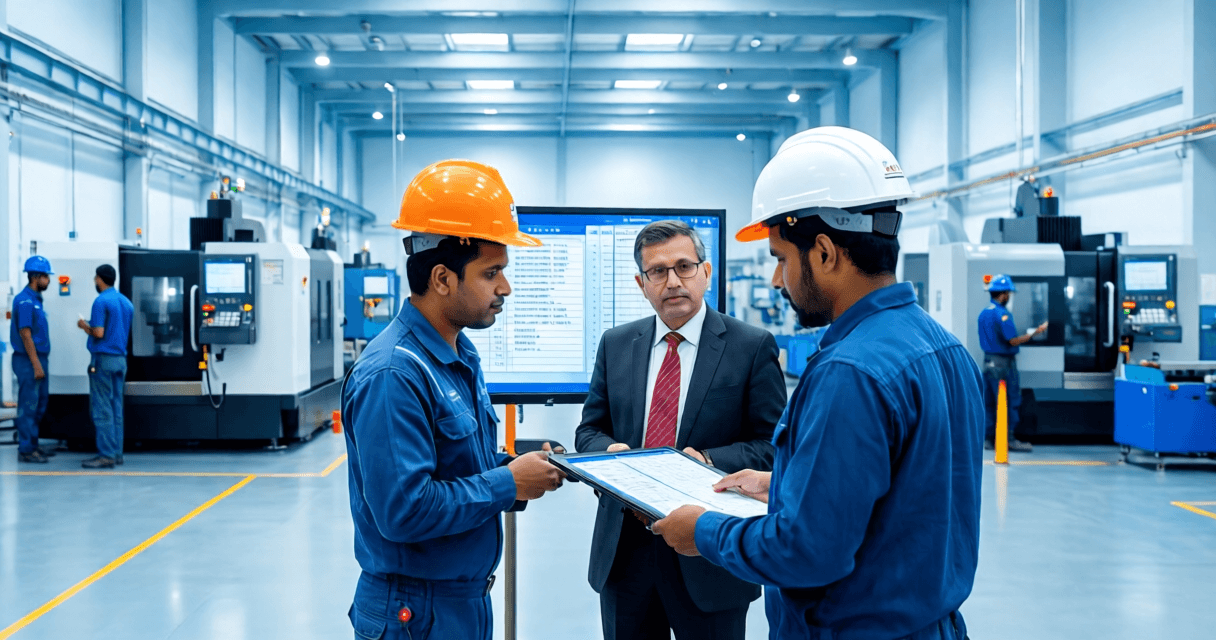

industrial machinery AMC annual maintenance contract Hyderabad fa
Factory downtime costs lakhs per hour. Learn how industrial machinery AMC annual mai gets resolved fast. MachineryFix connects you with verified technicians via Intelligent Dispatch.

MachineryFix Team
Industrial Repair & Maintenance Experts · 26 September 2026
Need this fixed?
Certified technicians, dispatched from our Hyderabad hub.
# Industrial Machinery AMC Annual Maintenance Contract: Hyderabad Factory Owners' Complete Guide
A single unplanned breakdown on a 20-machine shop floor in Kattedan Industrial Area costs between ₹50,000 and ₹5,00,000 in lost output before the first technician even reaches the gate. Multiply that by the 3 to 5 downtime events a typical MSME unit in Telangana logs per quarter, and the annual damage to margin is not a line item — it is a slow hemorrhage that shows up in your P&L as "overhead" while your client quietly shifts volume to a competitor in Sanathnagar. An industrial machinery AMC annual maintenance contract is the one maintenance decision that stops that bleed before the next monsoon turns dust ingress and 42-degree ambient heat into a chronic failure cycle across every VFD, servo drive, and hydraulic seal in your plant.
Understanding the Failure
A hydraulic press in a Jeedimetla packaging unit stalls at 02:00 on a Tuesday night. The operator logs the error code, pages the in-house fitter, and waits. By 08:00, three shifts of labour are idle on the floor. By 14:00, the client's delivery window has slipped, and the penalty clause in the supply contract kicks in. The root cause? A worn hydraulic seal that a scheduled inspection would have flagged two weeks earlier. The total cost of that single failure — overtime, expedited shipping, client penalty, and the rework to recover the missed quantity — crosses ₹2.3 lakh.
That scenario plays out across Hyderabad's 14 industrial clusters, from Nacharam IDA to Sanathnagar, where MSME manufacturers run between 8 and 40 machines simultaneously, most of them 5 to 15 years old. The average unplanned downtime event in a 20-machine shop floor occurs 3 to 5 times per quarter, and each event cascades: missed production targets, overtime backlogs, and a slow erosion of client confidence that no amount of follow-up phone calls repairs.
The problem is not that these failures are unpredictable. It is that the response infrastructure is fragmented. A plant manager in Kattedan might have a WhatsApp group with three different fitters, a parts vendor in Secunderabad, and a CNC specialist in Patancheru. Coordinating them during a live breakdown at 2 AM, when the 3-phase feeder in the IDA zone is already swinging ±12 percent under peak load, is where the real cost compounds. The MachineryFix platform exists to eliminate that coordination tax: its Intelligent Dispatch Engine matches the breakdown with the nearest identity-verified technician in the relevant specialisation, and the plant manager tracks the vehicle from dispatch to factory gate in real time.
A plant manager at Kattedan Industrial Area put it bluntly: "Downtime reduced significantly after switching to MachineryFix. Before, I was the dispatcher. Now I just run the line." That shift — from reactive coordinator to production-focused leader — is the entire value proposition of a structured annual maintenance contract backed by a verified repair network rather than a phone number scribbled on a sticky note.
Immediate Response Steps
When a machine goes down at 01:30 in a Bollaram textile unit, the first 90 minutes determine whether the repair takes 3 hours or 11. Experienced maintenance heads in Hyderabad's MIDC and IDA zones follow a specific sequence, and the order matters:
- Isolate and document. Lock out the machine, photograph the fault area, and note the exact error code, the last operating parameters, and the time the anomaly first appeared. A spindle that started vibrating 40 minutes before the trip is a different diagnosis from one that failed cold after a power cut. In older IDA zones like Uppal, where the feeder trips without warning during summer peak, that distinction is the difference between a bearing replacement and a full spindle rebuild.
- Contain the secondary damage. If a bearing has seized, do not attempt to force it free. If a hydraulic cylinder is leaking, shut the pump and close the isolation valve before the fluid contaminates the electrical cabinet. In Hyderabad's summer, ambient temperatures above 42 degrees accelerate thermal degradation on any partially failed component, and a 30-minute delay in isolation can turn a ₹15,000 seal job into a ₹90,000 cabinet replacement.
- Call with precision. The single biggest time-waster in machine repair in India is a technician arriving with the wrong parts. When you make that call, give the machine make, model, serial number, the specific symptom, and your exact IDA or SEZ gate number. Vague descriptions like "the machine is making a noise" add 2 to 4 hours to the resolution and often mean a second visit.
- Do not accept the first quote blindly. In a competitive repair market, the cheapest bid often means a technician who will use a generic part, skip the torque calibration, and be gone by the time the failure recurs in three weeks. The invoice looks fine. The machine is not.
This is where the competitive bidding model changes the dynamic. Instead of one fitter's word being the only option, you see two or three verified proposals side by side, each with a parts list, an ETA, and a firm rate. A textile unit manager at VNR Textiles, VNR Industrial Area, told us that MachineryFix matched them with the right hydraulic expert on the first call, and the side-by-side bidding saved them roughly 20 percent on the last repair. That margin, saved on a single job, funds a month of preventive inspections.
Common Root Causes
A consistent pattern emerges when you read through thousands of service logs across Telangana's manufacturing belt. The failures that cost MSME factories the most are rarely catastrophic mechanical events. They are slow-burn degradation problems that go unnoticed because no one is systematically inspecting them, and the four drivers below are almost always in play simultaneously:
- Voltage fluctuation and power quality. Hyderabad's industrial feeders, particularly in older IDA zones like Uppal and Secunderabad, experience voltage swings of 10 to 15 percent during peak summer demand when the TSDCL load hits its ceiling. VFDs, servo drives, and CNC controllers are designed for a ±5 percent window. The result is premature capacitor degradation, intermittent fault codes, and drive boards that fail without any visible warning. A CNC operator in Patancheru described watching the spindle speed drift from 8,000 to 6,200 RPM over three weeks before the drive board finally tripped — a failure that a quarterly electrical audit would have caught at the capacitor stage.
- Monsoon humidity and dust ingress. The June-to-September window in Telangana is brutal for electrical enclosures. Condensation forms on PCBs, contactors corrode, and fine dust from the factory floor settles into bearing races. A CNC machine in Patancheru that ran cleanly in March will show spindle runout issues by August if the enclosure gaskets have not been replaced. In textile units in Bollaram, where cotton lint is airborne 24/7, the problem is worse: the lint packs into servo motor windings and turns a 15-amp draw into a 22-amp draw, tripping the MCB at the worst possible moment.
- Deferred preventive maintenance. The most expensive repair is the one that was a 30-minute oil change six months ago. Filter bypasses, worn gear teeth, and fatigued hydraulic seals all follow predictable wear curves. When the wear curve crosses the failure threshold, the repair is no longer a 2-hour job. It is a 2-day job with a ₹80,000 parts bill and a production schedule that has already slipped.
- Skilled labour shortage. A 2024 survey of MSME maintenance teams in Telangana found that 60 percent of small factories have no dedicated CNC or hydraulic specialist on payroll. The in-house fitter, often ITI-certified with two or three years of shop-floor experience, handles everything from a broken belt to a servo calibration. The depth of expertise simply is not there, and the diagnostic tools to trace a failure to its origin are missing.
These four factors compound. A voltage spike weakens a capacitor. Monsoon dust clogs the bearing. The deferred oil change means the bearing has no lubrication to absorb the extra heat. And the in-house fitter, stretched thin across 12 machines, does not have the diagnostic tools to trace the failure to its origin. The result is a repeat repair, a second downtime event, and a client who is now questioning whether you can hit the next delivery date.
Preventive Actions
The cost of prevention is a fraction of the cost of cure, and the math is not close. A structured Predictive Maintenance AMC programme, executed by a verified external network rather than an overworked in-house team, addresses each of the root causes above with a specific, measurable action:
- Quarterly electrical audit. Every 90 days, a certified technician inspects VFD capacitors, servo drive terminals, contactor contacts, and grounding continuity. In a factory in Nacharam IDA, this single audit caught a failing capacitor bank on a hydraulic press that would have failed during the next monsoon week, saving an estimated ₹1.8 lakh in replacement parts and three days of downtime. The technician logged the reading, photographed the capacitor, and flagged the replacement window — all inside the Digital Service Catalogues, so the next visit picks up exactly where this one left off.
- Monthly lubrication and filter cycle. A documented schedule for bearing grease, hydraulic filter replacement, and air-line dryer checks, logged in the Digital Service Catalogues so that every intervention is traceable. This is the layer that most MSME factories skip, and it is the layer that separates a 2-hour repair from a 2-day shutdown. In a packaging unit in Jeedimetla, the monthly filter swap on the hydraulic power unit caught a metal particulate build-up that would have scored the cylinder bore within six weeks.
- Pre-monsoon enclosure and gasket inspection. In the two weeks before the first rain in Hyderabad, a walk-through of every electrical cabinet, checking gasket integrity, desiccant bags, and cable gland seals. This is a 4-hour job that prevents weeks of intermittent faults. In a compressor unit in Secunderabad, a cracked cable gland seal was the entry point for monsoon moisture that corroded the VFD PCB over a single night, costing ₹65,000 in a replacement board and two days of lost capacity.
- Annual calibration and alignment check. Spindle runout, table flatness, hydraulic pressure accuracy, and conveyor belt tracking. These are not "nice to have" checks. They are the difference between a CNC machine producing within 0.01 mm tolerance and one that is quietly producing scrap that the QC team catches 200 pieces later, after the client has already rejected the first lot.
The critical enabler for all of this is a Digital Service Catalogue that records every inspection, every part replaced, every torque value, and every diagnostic reading. A quality manager at a Cherlapally unit noted that the digital service logs are fantastic for ISO audits, because every record is timestamped, technician-verified, and exportable in a single click. No more searching through a shoebox of paper job cards when the auditor walks in and asks for the last 12 months of maintenance history on the hydraulic press.
Factory owners across Telangana can book a certified technician directly from their phone, with upfront pricing before any work begins, and the entire service history sits in one digital record tied to the machine's serial number. That continuity, across multiple technicians and multiple visits, is what transforms a reactive repair relationship into a genuine annual maintenance contract that protects the asset's value over its full operational life.
How MachineryFix Helps
The gap between "we know we need an AMC" and "we actually have a structured, verified, trackable maintenance programme running" is where most MSME factories in Telangana get stuck. The in-house team is stretched across 12 to 40 machines. The local fitter is reliable but generalist. The OEM service team charges a premium and carries a 5-day lead time for a single hydraulic seal. The plant manager is left as the dispatcher, the negotiator, and the quality checker, all before the 06:00 production start.
The Intelligent Dispatch Engine addresses the first bottleneck: matching. A hydraulic press fault in Balanagar does not wait for a general fitter from Uppal to finish his current job. The engine identifies the hydraulic specialist who is 12 kilometres away, has the right seal kit in his van, and can be at the factory gate within 90 minutes. The plant manager sees the technician's live location, the ETA, and the verified identity badge before the vehicle even leaves the highway. No phone calls. No "I'll be there in a couple of hours."
The Vetted Technician Network addresses the second bottleneck: competence. Every engineer and technician in the network passes a rigorous skill evaluation, an identity check, and a practical diagnostic assessment before they are eligible to accept a single job. A CNC service technician on the network has demonstrated, in a controlled test, that they can diagnose a servo drive fault, read the error log, and replace a failing encoder before they are allowed to take a factory call. That bar is what separates a verified expert from a WhatsApp-group fitter who has watched a YouTube video on VFD troubleshooting.
The process on the factory side is four steps, and none of them require the plant manager to leave the production floor:
1. Describe the problem. Symptoms, error codes, machine make, model, and gate location. Two minutes on the phone or in the app. 2. Get matched instantly. Proximity-based matching with competitive bids and ETAs. Compare proposals before accepting. No single-point dependency. 3. Technician arrives. Live status tracking, identity verified at the factory gate. The technician carries OEM-grade parts and the tools for the specific machine class. 4. Back up and running. Digital job card with parts list, torque values, and diagnostic readings. The manager approves and pays. The record is logged against the machine's serial number.
The entire interaction stays inside the app. No phone numbers are exchanged. No communication leaks to a third party. The mutual rating system means both the factory and the technician score each other after every job, and the 4.8/5 average rating across completed jobs is not a marketing figure — it is the aggregate of thousands of two-way feedback entries.
The Predictive Maintenance AMC module takes this further. Instead of waiting for a failure, the factory schedules quarterly inspections, monthly lubrication cycles, and pre-monsoon audits through the same verified network. Each visit generates a Digital Service Catalogue entry. Each entry builds a trend line. If the hydraulic pressure on a press in Jeedimetla has been drifting down 0.3 bar per month for six months, the system flags it before the seal fails. That is the difference between a repair and a prevention, and it is the difference between a ₹2.3 lakh downtime event and a ₹4,000 seal replacement.
A Suresh Nair at Balanagar Industrial Zone reported that the press line turnaround improved dramatically after he started using the platform, because the right specialist arrived with the right parts on the first visit, every time. "Before, I was on hold with three different people while the machine sat dead. Now I get one call, one ETA, and one technician who knows the machine."
Why MachineryFix Is India's Fastest Repair Network
Speed in industrial repair is not about one technician driving faster. It is about the entire system eliminating the delays that accumulate between "I have a problem" and "the machine is running again." In the traditional model, those delays are: finding the right fitter, negotiating a rate, waiting for the right parts, hoping the fitter has the right tools, and praying the fix holds. Each of those steps adds 1 to 6 hours. Multiply that by a 2 AM breakdown and a 6 AM production start, and the cost is not just money. It is a client who does not call back next quarter.
MachineryFix compresses that timeline to its minimum. The Intelligent Dispatch Engine removes the "finding" step. The competitive bidding model removes the "negotiating" step. The Vetted Technician Network, with parts stocked in the technician's van, removes the "waiting for parts" step. The Digital Service Catalogue removes the "hoping the fix holds" step, because the previous repair history tells the technician exactly what was done last time and what the wear curve looks like.
This is the lived experience of factory managers across Hyderabad's industrial belt. A plant manager in Kattedan reduced unplanned downtime significantly after switching from a WhatsApp-group dispatch model. A textile unit in VNR got the right hydraulic expert on the first call. A quality manager in Cherlapally now walks into ISO audits with a clean digital trail instead of a shoebox of paper. A press line in Balanagar runs on schedule. A packaging unit in Jeedimetla saved 20 percent on a repair through transparent bidding. These are not marketing lines. They are the operational outcome of a system designed for the Indian MSME factory, with its voltage swings, its monsoon dust, its stretched maintenance teams, and its zero tolerance for a second missed delivery.
If your factory is in Uppal, Kattedan, Balanagar, Jeedimetla, Cherlapally, Secunderabad, Patancheru, Nacharam IDA, Bollaram, or Sanathnagar, and you are still coordinating repairs through a WhatsApp group and a phone number on a sticky note, the cost of that model is already in your P&L. You do not need to overhaul your maintenance department. You need a verified, dispatch-optimised, digitally logged repair network that treats your machine's uptime as its own KPI.
[Book a Technician at machineryfix.com/#book](https://machineryfix.com
Published on
India's on-demand industrial repair platform — certified technicians dispatched fast.
Frequently Asked Questions
How do I get a technician for industrial machinery AMC annual mai in Hyderabad?
MachineryFix's Intelligent Dispatch Engine matches your breakdown with the nearest verified technician in Hyderabad. Available 24/7 for emergency support. Book at machineryfix.com or WhatsApp +91 70133 33007.
Are MachineryFix technicians verified and experienced?
Yes. Every technician on MachineryFix is an experienced engineer or technician, passing rigorous skill evaluation before being onboarded. This is why MachineryFix maintains a 4.8/5 average rating from factory clients across India.
What is a Predictive Maintenance AMC and how does it work?
A Predictive Maintenance AMC (Annual Maintenance Contract) from MachineryFix covers scheduled inspections, condition monitoring, and priority emergency response. It reduces unplanned breakdowns by 40-60% and is ideal for factories running critical CNC, hydraulic, or textile machines.
How much does industrial machine repair cost in India?
Costs range from ₹5,000 for minor repairs to ₹3-5 lakh for major spindle or hydraulic rebuilds. MachineryFix uses competitive bidding — you receive upfront proposals from multiple local experts before committing, so you always get a fair price.
What documentation does MachineryFix provide after a repair?
MachineryFix generates a Digital Service Catalogue entry for every job — logging the fault, diagnosis, parts replaced, technician ID, and timestamps. This digital job card is accepted for ISO 9001 and GMP compliance audits.
Can I rehire the same technician for future jobs or an AMC?
Yes. MachineryFix's re-hiring feature lets you save a preferred technician directly to your account. You can rebook them for follow-up work, recurring maintenance, or a full AMC contract — keeping your factory history consistent.
Need a certified technician?
Get one dispatched fast.