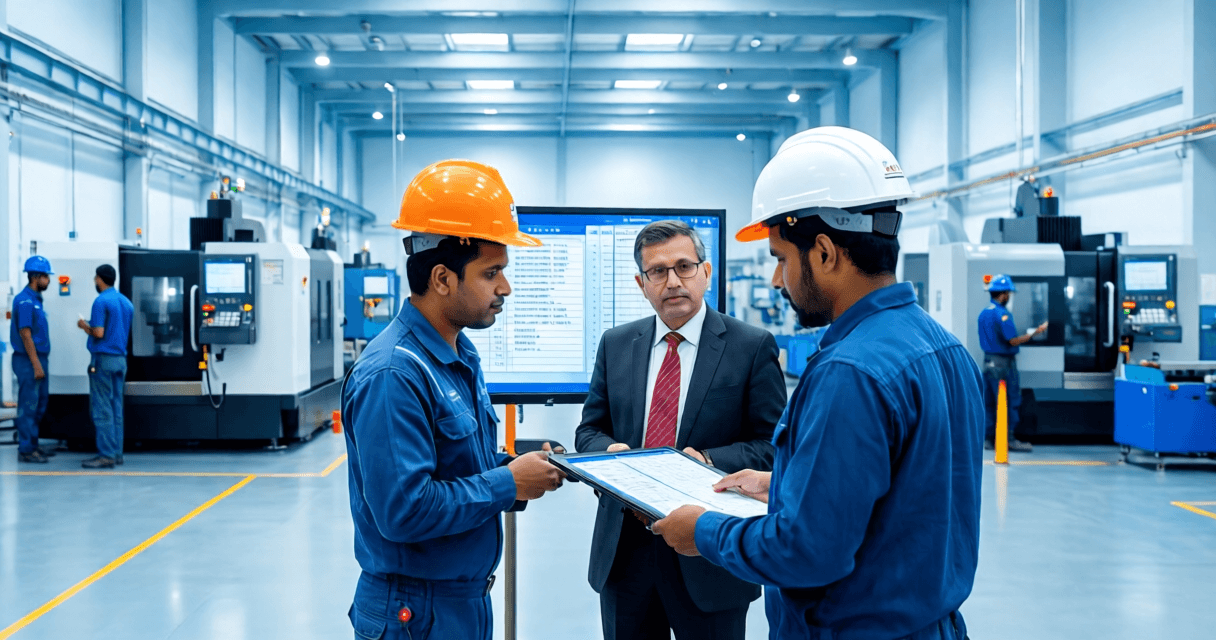

competitive bidding machinery repair cost savings Hyderabad MSME
Factory downtime costs lakhs per hour. Learn how competitive bidding machinery repai gets resolved fast. MachineryFix connects you with verified technicians via Intelligent Dispatch.

MachineryFix Team
Industrial Repair & Maintenance Experts · 8 October 2026
Need this fixed?
Certified technicians, dispatched from our Hyderabad hub.
# Competitive Bidding Machinery Repair: How Hyderabad MSMEs Cut Repair Costs by 30–50%
A single 6-hour breakdown on a packaging machine in Jeedimetla erases an entire day's output, triggers penalty clauses with OEM clients, and drags a unit's OEE below the 70 percent line that separates a profitable operation from one running on fumes. In a CNC shop in Uppal or a hydraulic press line in Kattedan Industrial Area, every idle minute of spinning spindles and cooling compressors burns between ₹50,000 and ₹5,00,000 in lost production. That is the arithmetic that has pushed plant managers and maintenance engineers across Telangana's manufacturing belt toward a procurement model they did not need five years ago: competitive bidding machinery repair. The shift from accepting a single technician's quoted rate at face value to comparing multiple itemised bids before a wrench touches a bolt has rewritten the cost structure for MSMEs who previously absorbed 30 to 50 percent premiums on every emergency call-out.
Understanding the Failure
The most expensive breakdowns in Hyderabad's manufacturing ecosystem are rarely the dramatic ones. A seized bearing on a lathe machine in Sanathnagar that takes 40 minutes to diagnose costs far more than the ₹3,200 bearing itself. The real loss sits in the 4 to 6 hours of waiting for a spare, the 2 hours of disassembly, the 1 hour of re-calibration, and the 3 hours of rework to pull first-article quality back within tolerance. The machine was never the problem. The problem was the information gap between the factory floor and the repair vendor.
A textile mill in the VNR Textiles cluster ran into this gap last year. A Jacquard head on a 32-end loom started producing skipped picks. The in-house technician blamed the yarn feed, reordered material, and lost two full shifts before the actual root cause — a worn cam follower with 0.4 mm of play — was identified. Two shifts at ₹18,000 per hour in thread and labour means ₹288,000 evaporated in a single misdiagnosis. No second opinion. No benchmark. No digital record of what was actually done, what parts were swapped, or whether the fix would hold through the next monsoon humidity cycle.
The cost of that opacity multiplies across a plant. A compressor in a plastic injection unit in Patancheru fails on a Tuesday. The owner calls his usual technician, who quotes ₹45,000 for a "full overhaul." There is no way to verify whether a ₹12,000 valve replacement would have solved the problem. The owner pays, because the line is down and the order ships on Thursday. That single transaction, repeated across five machines in a year, is where the 30 to 50 percent premium lives.
The repair cost you pay is not a fixed number. It is a market price, and like every market price in India, it responds to competition, transparency, and the number of qualified bidders who can actually do the job. Closing that procurement gap is the single highest-leverage move a maintenance head in Balanagar or a plant manager in Nacharam IDA can make this quarter.
Immediate Response Steps
The first 30 minutes after a 2 a.m. breakdown in a Uppal factory determine whether total downtime lands at 3 hours or 14. A structured response protocol is not a luxury for a 200-worker unit; it is the difference between a controlled repair and a production catastrophe.
- Isolate and document. Power down the affected axis or section. Photograph the error code on the CNC control panel, note the hydraulic pressure reading, and record the exact symptoms. Do not attempt a "test run" to see if it restarts. In a hydraulic press in Kattedan, one test cycle with a cracked seal can destroy the accumulator and multiply the repair bill by four.
- Capture the digital footprint. If your machine has a PLC or a modern servo drive, export the fault log. A 30-second file transfer to a USB drive gives any technician arriving at the gate a head start. This is the detail that separates a 2-hour fix from a 6-hour guess.
- Initiate the multi-bid process. Instead of dialling one number and accepting the first quote, open the MachineryFix platform and describe the breakdown: machine make, model, symptom, error code, and your exact location in the industrial area. The Intelligent Dispatch Engine cross-references that input with the real-time availability and skill profile of certified experts in your radius and returns multiple bids with ETAs within minutes. You compare proposals side by side, verify skill ratings, and accept the one that fits your timeline and budget.
- Verify at the gate. When the technician arrives, check the identity badge and the digital profile. Every engineer in the Vetted Technician Network has passed identity checks and a practical skill evaluation on the specific machine class before onboarding. The person standing at your gate has logged verified repairs on that equipment type, not just a general fitter's certificate from an ITI in 2014.
- Approve before work begins. Read the proposed scope, the parts list, and the total cost. Nothing is opened until you sign off. This single step eliminates the "the repair turned out to be more than expected" conversation that has cost Hyderabad MSMEs lakhs in surprise charges over the past two years.
A plant manager at Kattedan Industrial Area reported that after switching to this structured, multi-bid approach, his unit's unplanned downtime dropped significantly within one quarter. The difference was not better machines. It was faster, more transparent decision-making in the first 30 minutes of every breakdown.
Common Root Causes
The same five failure patterns account for roughly 80 percent of emergency call-outs across CNC machines, hydraulic presses, compressors, and conveyor systems in Hyderabad's manufacturing corridor. Recognising these patterns lets a maintenance engineer triage faster and lets a plant manager ask sharper questions when reviewing a repair quote.
- Voltage fluctuation and power quality. Telangana's industrial feeders, particularly in the outer IDA zones like Bollaram and Sanathnagar, experience voltage swings of 10 to 15 percent during peak summer loads. A CNC spindle drive rated for 415 V sees its IGBT modules degrade 3 to 4 times faster under sustained overvoltage. The visible symptom is intermittent E-stop triggers or axis drift. The invisible cost is a drive board that fails at 3 a.m. on a Sunday, when the on-call technician is two hours away and the only alternative is a general electrician from the local market.
- Dust ingress and monsoon humidity. The Hyderabad monsoon, particularly the June-to-September window, pushes relative humidity past 90 percent in poorly sealed factory sheds. In a welding equipment bay or a textile finishing line, that moisture corrodes sensor contacts, degrades solder joints on PCBs, and causes condensation inside hydraulic accumulators. A compressor in Jeedimetla that runs fine in February throws a high-pressure fault in August if the air dryer is undersized for the humidity load.
- Deferred preventive maintenance. The most common root cause is also the least discussed. MSMEs in the region run machines 14 to 16 hours a day, 6 days a week, and defer lubrication, filter changes, and alignment checks to "next month." A lathe machine whose way lube system has not been serviced in 8 months will show a chatter mark on the first heavy cut of the ninth month. The repair is not the chip; the repair is the 3 hours of way re-lapping and the ₹1.2 lakh in lost capacity while the machine sits.
- Operator technique and overload. In a 20-person CNC shop, the operator running the night shift is not the same operator who calibrated the tool offsets. A 2 mm feed rate increase, a missing workholding clamp, a forgotten coolant flush — these small deviations accumulate into bearing fatigue, spindle runout, and eventually a catastrophic gear mesh failure that no amount of emergency bidding can fix in under 12 hours.
- Aging OEM parts without spares inventory. Many MSMEs in Hyderabad run machines from 2008 to 2014. The OEM parts for those vintages are no longer stocked locally. A single encoder on a 12-year-old Mazak or a pressure transducer on a 2010 hydraulic press can take 10 to 14 days to source, and that is if the part still exists in the global supply chain. The machine sits. The order slips. The penalty clause activates.
These root causes are structural to the Indian MSME manufacturing model. They compound when the repair process itself is opaque, slow, and locked to a single vendor who has no incentive to diagnose accurately because the diagnosis is invisible to the buyer.
Preventive Actions
Building a preventive maintenance discipline around the machines you already own is the highest-ROI activity in the entire factory. The knowledge is not scarce. The execution is. A plant manager in Secunderabad or a maintenance engineer in Cherlapally who institutes a 200-hour service interval, tracks vibration trends, and maintains a digital log for every machine will cut emergency call-outs by more than half within two quarters.
- Institute a 200-hour service interval. Whether it is a compressor, a hydraulic press, or a CNC machining centre, a 200-hour logged service window for lubrication, filter replacement, and belt tension check catches 70 percent of mechanical failures before they become breakdowns. The cost of a scheduled 4-hour service is a fraction of the 12-hour emergency repair it prevents, and the technician arrives on your schedule, not the machine's.
- Track vibration and temperature trends. A ₹2,000 vibration pen used weekly on bearing housings, combined with an infrared thermometer on motor windings, gives you a 2 to 3 week early warning on bearing wear, misalignment, or winding insulation breakdown. This is not predictive analytics at a billion-dollar plant. This is a ₹4,000 tool kit and a 10-minute weekly walk around the shop floor.
- Maintain a digital service log for every machine. Every repair, every part replaced, every calibration adjustment — logged with date, technician name, part number, and cost. When a compressor in Patancheru throws a fault for the third time in 8 months, the log tells you whether the root cause was the same valve, the same solenoid, or a systemic pressure issue in the line. Without the log, every repair starts from zero, and every technician re-diagnoses what the last one already found.
- Contract a Predictive Maintenance AMC. Rather than reacting to failures, a structured annual maintenance contract with scheduled inspections, condition monitoring, and priority response shifts your maintenance model from reactive to proactive. For a 10-machine unit in Balanagar, the AMC cost typically runs 15 to 20 percent less than the cumulative cost of 3 to 4 emergency call-outs in the same period, and the technician already knows your machines, your spares, and your production schedule.
- Train your operator on pre-shift checks. A 5-minute checklist — listen for unusual noise, check for oil seepage, verify coolant level, confirm no error codes on the HMI — catches the small issues that become big ones by 2 p.m. In a 2-shift operation in Kattedan, the operator who starts the second shift is the last line of defence before a minor seal leak becomes a full hydraulic pack replacement.
A maintenance head in Cherlapally noted that digital service logs became a critical asset during their ISO 9001 surveillance audit. The auditor spent 40 minutes in the maintenance file and closed the observation in one pass. That is the compounding value of documentation done right from the first repair onward, and it is a value that no amount of emergency call-outs can replicate.
How MachineryFix Helps
The gap between a broken machine and a running machine is a system problem, not a wrench problem. It requires matching the right expert to the right failure, at the right speed, at a transparent price, with a verifiable skill credential and a digital record of the work performed. The MachineryFix platform operates on that logic, and it functions differently from the "call my uncle's mechanic" model that still dominates Indian MSME maintenance in tier-2 and tier-3 industrial clusters.
The Intelligent Dispatch Engine takes your breakdown description — machine type, symptom, error code, location — and cross-references it with the real-time availability and skill profile of technicians in your radius. A hydraulic press failure in Kattedan does not get routed to a general fitter in Secunderabad. It gets matched to a hydraulic specialist who has logged 40-plus press repairs and is currently 4 kilometres away. The ETAs on the returned bids reflect actual travel time from the technician's GPS position, not a hopeful estimate over a crackling phone line.
The competitive bidding model changes the economics of the transaction. You see three or four proposals with itemised parts, labour hours, and a total. You are not locked into the first number someone shouts over the phone. A plant manager in Jeedimetla reported that competitive bidding saved his unit 20 percent on a packaging machine repair because the lowest bid was for a targeted actuator replacement rather than a full gearbox swap that the diagnosis did not yet justify. The savings were not a discount. They were the correct scope of work, surfaced by a second and third qualified opinion.
The Digital Service Catalogues mean that every job, from the first diagnostic to the final torque check, is logged in a structured format. Part numbers, serials, pre- and post-repair readings, technician notes — all searchable, all exportable. For a factory preparing for a customer audit or an ISO certification cycle, this is the evidence file that separates a compliant operation from one that is perpetually scrambling through carbon-copy invoices under a desk.
The Vetted Technician Network ensures that the person walking through your gate has passed identity verification and a practical skill evaluation specific to the machine class you are calling about. There is no "I have fixed a lathe once in 2016" uncertainty. The skill is assessed, documented, and visible in the profile before you accept the bid. The mutual rating system then closes the loop: you rate the diagnosis, the communication, and the finish. The technician sees your rating. Over time, you build a shortlist of trusted experts and rehire them for your next service or your AMC cycle.
Indian factory owners can book a certified technician directly from their phone, with upfront pricing before any work begins. The entire process — from dispatch to gate arrival to job card sign-off — stays inside a single, secure interface. No WhatsApp screenshots of half-typed quotes forwarded between three subcontractors. No phone tag. One thread. One record. One accountable expert.
Why MachineryFix Is India's Fastest Repair Network
Speed in industrial repair is not about one fast technician. It is about eliminating every minute of friction between the moment a machine stops and the moment it starts again. In a Hyderabad factory, that friction lives in four places: finding the right expert, verifying their skill, agreeing on a fair price, and confirming the work was done correctly. MachineryFix compresses all four into a single digital workflow, and the result shows up in the numbers.
The platform holds a 4.8/5 average rating across its service network. That figure reflects not just technical competence but the full arc of the customer experience: dispatch speed, gate-to-job-card turnaround, parts quality, and post-repair follow-up. A plant manager at Balanagar Industrial Zone put it plainly: "Press line turnaround improved dramatically with MachineryFix." Behind that sentence is a production schedule that held, a client penalty that did not trigger, and a shift that closed on time.
The 24/7 emergency support line means that a 3 a.m. spindle alarm in a Patancheru CNC shop gets the same dispatch response as a 10 a.m. call. The Intelligent Dispatch Engine does not sleep, does not take a lunch break, and does not need to "call back in an hour." The match is algorithmic, proximity-based, and skill-filtered. The technician is already en route before you have finished your first cup of filter coffee.
The Digital Service Catalogues mean that your maintenance history is not a folder of crumpled carbon-copy invoices under a desk. It is a structured, searchable, exportable record that your ISO auditor, your customer's quality team, and your own planning team can access in seconds. The Predictive Maintenance AMC builds on that record to schedule interventions before the failure window opens, shifting your cost curve from emergency-premium to scheduled-standard.
When you need a second opinion, a different specialist, or a repeat job with the same technician, the platform's rehire and competitive bidding features keep the market working in your favour. You are never locked into a single vendor's pricing or availability. The technician network spans 14 industrial categories — CNC machines, lathes, hydraulic presses, compressors, welding equipment, conveyor systems, packaging machines, textile machines, and more — across pan-India coverage, with weekly payouts to technicians that keep the network responsive and the skill pool deep.
For a manufacturing unit in Hyderabad — whether it is a 6-machine CNC shop in Uppal, a 40-press textile unit in Kattedan, or a compressor-heavy plastics plant in Bollaram — the arithmetic is unambiguous. Downtime is the single largest controllable cost in your P&L. The way you procure repair is the single largest lever you have to reduce it. Competitive bidding machinery repair, verified technician credentials, and a digital service trail are not luxuries for a 200-worker unit. They are the operating system that keeps your OEE above the line your client expects and your margin above the line your bank expects.
The next breakdown will come. It always does. The question is whether you will spend 4 hours on the phone negotiating a single opaque quote, or 10 minutes comparing three itemised bids from verified experts who are already 4 kilometres away. Call or WhatsApp +91 70133 33007, or book a certified technician now. The machine is not going to fix itself. The market, however, will fix your cost structure — if you let it.
Published on
India's on-demand industrial repair platform — certified technicians dispatched fast.
Frequently Asked Questions
How do I get a technician for competitive bidding machinery repai in Hyderabad?
MachineryFix's Intelligent Dispatch Engine matches your breakdown with the nearest verified technician in Hyderabad. Available 24/7 for emergency support. Book at machineryfix.com or WhatsApp +91 70133 33007.
Are MachineryFix technicians verified and experienced?
Yes. Every technician on MachineryFix is an experienced engineer or technician, passing rigorous skill evaluation before being onboarded. This is why MachineryFix maintains a 4.8/5 average rating from factory clients across India.
What is a Predictive Maintenance AMC and how does it work?
A Predictive Maintenance AMC (Annual Maintenance Contract) from MachineryFix covers scheduled inspections, condition monitoring, and priority emergency response. It reduces unplanned breakdowns by 40-60% and is ideal for factories running critical CNC, hydraulic, or textile machines.
How much does industrial machine repair cost in India?
Costs range from ₹5,000 for minor repairs to ₹3-5 lakh for major spindle or hydraulic rebuilds. MachineryFix uses competitive bidding — you receive upfront proposals from multiple local experts before committing, so you always get a fair price.
What documentation does MachineryFix provide after a repair?
MachineryFix generates a Digital Service Catalogue entry for every job — logging the fault, diagnosis, parts replaced, technician ID, and timestamps. This digital job card is accepted for ISO 9001 and GMP compliance audits.
Can I rehire the same technician for future jobs or an AMC?
Yes. MachineryFix's re-hiring feature lets you save a preferred technician directly to your account. You can rebook them for follow-up work, recurring maintenance, or a full AMC contract — keeping your factory history consistent.
Need a certified technician?
Get one dispatched fast.